Twenty context blocks assembled per turn, and the output schema derived from which ones arrived
Prompts built by string concatenation at the call site drift from whatever you tested, and the context an agent actually saw is thrown away the moment it replies. Here assembly is a subsystem: twenty blocks loaded in parallel, volatile facts grounded in SQL rather than recollection, and an output schema derived from which blocks arrived — so the model is never asked for a field this turn cannot fill. Nothing in it counts a token, which is the honest gap.
10 min read
Contents
A woman opens her app and asks her agent what it makes of a man she has been matched with. Before it answers, the system has to know who he is, what he has proved, who else is interested in him, how he ranks against them right now, what he has already told other agents, and what the two of them have said so far.
Six groups of facts, about twenty separate database reads, all of it assembled into a single prompt in the time it takes her to look up from the screen.
If you build that with string concatenation at the call site — which is how it usually starts — two things go wrong. The prompt drifts from whatever you tested, because the test built its own copy. And the context the agent actually saw is discarded the moment it replies, so when it says something strange you are debugging blind.
So assembly here is a subsystem with its own module boundary, its own concurrency and its own tests. That is the part worth copying. It also contains the largest single gap in this architecture, which I will come to.
What gets loaded before a word is written
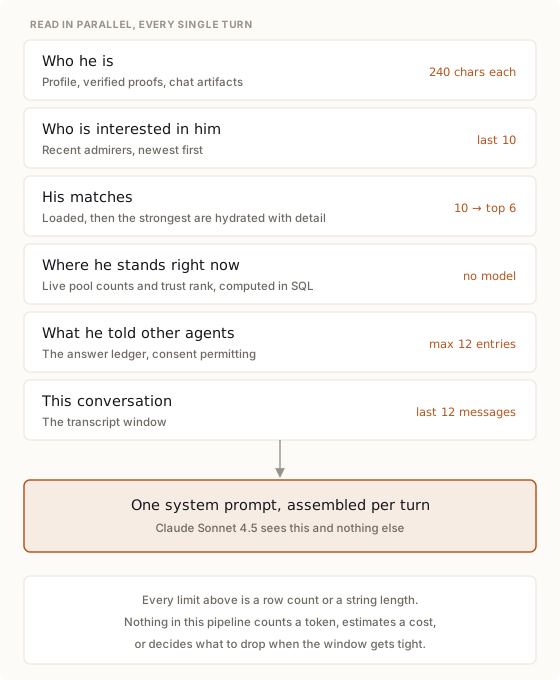
Six groups, roughly twenty blocks, all fetched concurrently and then concatenated into one system prompt.
A few of them are worth naming individually.
Where he stands right now is computed in SQL — live counts of who is active in his pool, and his trust rank among them. No model touches it. This exists because agents are extremely willing to invent a competitive picture if you let them, and a real number in the prompt is the cheapest way to stop that.
What he told other agents is the answer ledger from the previous post — capped at twelve entries, and only present at all if consent allows.
His matches shows the shape of the whole thing. Ten are loaded, and only the strongest six get hydrated with bio, preferences and recent messages. The other four exist as names. That is a relevance decision made in plain code before the model sees anything.
The output schema is built from the input
This is the part I have not seen elsewhere, so it is worth spelling out.
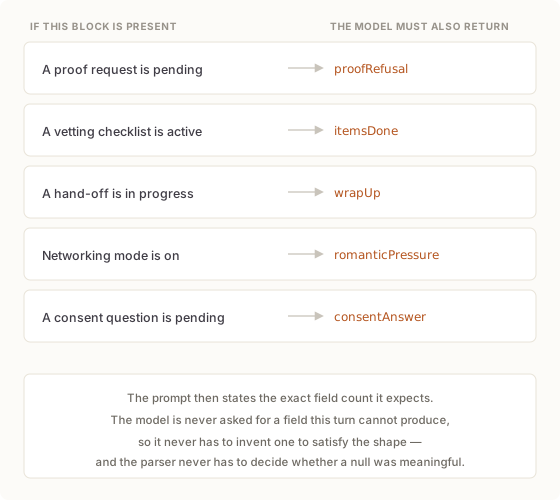
The agent returns structured JSON, not prose. But the shape of that JSON is assembled at the same time as the context.
If there is no proof request pending this turn, the output schema has no field for a proof refusal. If no checklist is active, there is no field for completed items. The prompt finishes by stating the exact number of fields expected, and that number changes turn to turn.
The reason is that a fixed schema teaches a model to fill things in. Ask for twelve fields when only nine are meaningful, and you will get twelve — three of them invented to satisfy the shape. Then your parser has to decide whether a null meant "nothing to report" or "the model didn't know", and those two cases need opposite handling.
Building the schema from the context removes the question. A field that could only be noise this turn is simply not requested.
Everyone arrived at context in 2026
Across the conferences I went to this year, context assembly went from a footnote to the headline act in about twelve months.
The clearest single moment: at the Data Engineering Summit in May, three consecutive talks in the same hall — MathCo, Tiger Analytics and EPAM — independently argued that enterprise AI failure is a context problem rather than a model problem. Two of them used nearly the same title. One was headed Data Rich. Context Poor.
| Idea | Where | What it says |
|---|---|---|
| Context as the scarce resource | Data Engineering Summit 2026 | Three consecutive talks, same diagnosis, no coordination |
| Context warehouse vs data warehouse | MLDS 2026 | A data warehouse records what happened. A context warehouse records why an expert decided X in situation Y |
| Ontology-driven multi-hop assembly | Data Engineering Summit 2026 | A worked traversal answering "why did Q4 growth decline", pruning dead branches — summarised as this is reasoning, not retrieval |
| Context products, not raw chunks | Data Engineering Summit 2026 | A seven-step serving path ending in token-budgeted assembly of structured context, then a decision trace written back as audit |
| Four memory types, four operations | DataHack Summit 2025 | Retrieval demoted to one of four types. The operations on the window: compress, isolate, trim, filter |
That last one is from August 2025 and it is the most useful framing I found, because it is a checklist you can hold your own system against.
Four operations, and we only do two properly
| Operation | What it means | riteangle |
|---|---|---|
| Filter | Only load what this turn could plausibly need | Yes. Blocks are conditional; most turns load a subset |
| Isolate | Keep sources separated so they cannot contaminate each other | Yes. Every block is loaded and labelled separately, and the ledger is structurally prevented from carrying its origin |
| Trim | Cut what does not fit | Crudely. Fixed row counts and character slices, chosen by hand |
| Compress | Summarise older material to retain meaning at lower cost | Offline only. Per-match summaries and extracted preferences are generated on a schedule and stored — but nothing compresses at generation time |
Trim is the weak one. "Last twelve messages" is a guess that happens to work. It is not responsive to whether those twelve messages are one-word replies or four paragraphs each.
The gap: nothing counts tokens
There is no tokeniser in this codebase. Nothing counts tokens, estimates a cost, or decides what to evict when the window tightens.
What exists instead is a set of hand-chosen limits: twelve messages, ten matches narrowed to six, ten admirers, twelve ledger entries, 240 characters here, 120 there. They were picked by looking at output and adjusting.
There is a comment in the conversation-history module saying that beyond twelve turns the thread is summarised. That summarisation is not implemented. The code takes the last twelve turns and drops the rest. I found it while researching this post, which is its own small lesson about comments.
Set against the EPAM talk describing token-budgeted assembly of structured context products, this is plainly behind. They have a budget and allocate it. I have constants that were right when I chose them.
The honest defence is that it has not hurt yet, because these prompts are nowhere near the context limit. The honest concern is that this design gets more wrong as it grows, not less — every new block is another fixed allocation competing with the others, and nothing arbitrates. The first time a user with a very long history meets an agent with a very full prompt, the failure will be silent: slightly worse answers, no error.
One related omission worth naming: prompt caching is not used on these prompts. Two minor routes use it. The large advisor and proxy prompts — the ones with twenty blocks in them, substantially identical between turns — do not. That is a straightforward cost saving sitting untaken.
The bit I would keep
If I rebuilt this tomorrow, one decision carries over unchanged: the context loaders are shared with the test harness by construction.
The admin test suite does not reimplement context assembly for testing. It calls the same loaders production calls, then declines to persist anything. It is impossible for the tested prompt and the live prompt to drift, because they are produced by the same code.
That sounds obvious and it is surprisingly rare. The usual pattern is a test fixture that starts accurate and quietly rots, until you are debugging a prompt that no user has ever received.
The pattern, without the dating app
Treat context assembly as a subsystem with its own module boundary, its own concurrency, and its own tests — not as string formatting at the call site. Load blocks independently and in parallel. Make each block conditional. Derive the output schema from which blocks arrived. Ground volatile facts in a query rather than the model's recollection. And share the assembly code with whatever you use to evaluate it.
| Setting | The blocks being assembled | The volatile fact to ground in SQL |
|---|---|---|
| Customer support | Account state, entitlements, recent tickets, product config, outage status | Current plan and open incidents — never the model's memory of them |
| Clinical decision support | Problem list, medications, allergies, recent labs, care-plan stage | Active medication list, as of now |
| Field service | Asset history, warranty state, parts availability, technician skills | Stock on hand at the nearest depot |
| Sales | Account tier, contract terms, open opportunities, prior conversations | Current pricing and discount authority |
| Fraud and risk review | Transaction history, device signals, prior decisions, policy version | The policy version in force at the transaction date |
Three transfers worth the effort:
Load in parallel, not in sequence. These blocks are independent reads. Sequential loading turns twenty round-trips into latency the user watches. This is plain engineering, and it is the difference between a two-second and a six-second reply.
Ground the volatile facts in a query. Anything a model would confabulate — counts, rankings, current status, effective policy — should arrive as a computed value inside the prompt. A number in the context is cheaper than any amount of instruction telling the model not to guess.
Derive the schema from the context. If your agent returns structured output, build the required fields from what is actually present. It removes a whole class of ambiguity from the parser and stops the model padding.
And the anti-pattern to avoid, which I am currently guilty of: do not let hand-tuned constants stand in for a budget. Row limits are fine as a first version. They stop being fine when blocks multiply, because nothing is deciding what matters when they compete.
References
Most sessions here have no published recording. Where one exists it is linked.
| Source | Event | Recording |
|---|---|---|
| Context at the core; token-budgeted assembly of structured context products | Data Engineering Summit 2026, May 2026 | Not published |
| Context warehouse versus data warehouse | MLDS 2026, Mar 2026 | Not published |
| Ontology-driven multi-hop reasoning over a context graph | Data Engineering Summit 2026, May 2026 | Not published |
| Context engineering: four memory types, four window operations | DataHack Summit 2025, Aug 2025 | Not published |
| Architecture of context engineering | DataHack Summit 2026, Aug 2026 | Not published |
| Agentic knowledge-augmented generation — Arun Prakash Asokan | DataHack Summit 2025 | Recording |
| Full hall recordings, several context and retrieval sessions | CYPHER 2025, Sept 2025 | Day 2, Hall 3 |
Fourth of nine posts on riteangle's architecture. Previous: cross-thread agent memory without cross-user leakage. Next: a hand-off that expires in 48 hours, and reverses instead of deleting.