Application-layer regex against managed guardrails: choosing by who has to sign the rule off
A safety rule written in your own code can be read, reviewed and approved by a domain expert, and protects exactly the one route you remembered to wire it into. The same rule bought as managed infrastructure is opaque, catches paraphrase you never enumerated, and applies to every path including ones written six months from now by someone who never read your docs. Having built both, the split I would defend is to write the rules you must be able to defend, and buy the rules you must not be able to forget.
6 min read
Contents
Two questions decide where a safety rule lives, and they pull in opposite directions.
Can somebody outside engineering read this rule and approve it? A clinician can read a list of phrases and sign it off. Nobody can meaningfully sign off "the model detects emergencies", because there is nothing to read.
Will somebody add a second route six months from now and forget this exists? A check written into one request handler protects that handler. It does not protect the endpoint added later by a person who never opened your safety documentation.
I have now built the same class of protection both ways. In a deterministic keyword gate ahead of the LLM the whole thing is application code — a keyword list before the call, forbidden patterns after it — and that post admits the limit plainly: pattern matching enforces the rules you thought to write. In a later project the equivalent protection is a managed guardrail wrapping the model, catching paraphrase I never enumerated and applying to every caller automatically.
Having both is more useful than either, because the answer turns out not to be a preference.
Account identifiers, resource names and endpoints are omitted throughout.
The two shapes
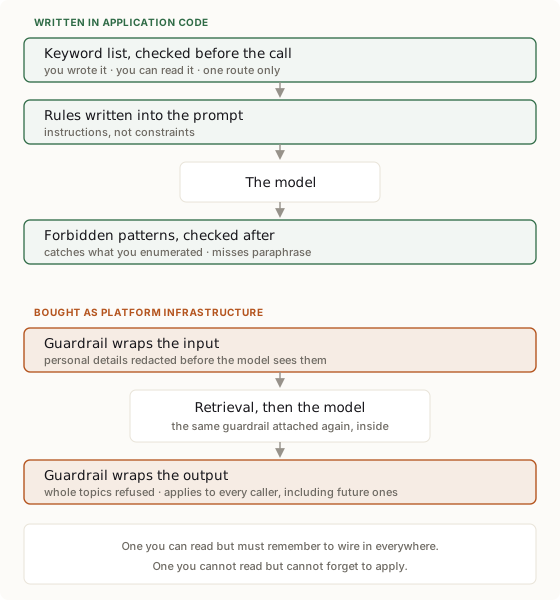
The second system provisions a managed guardrail and attaches it in two places: to the model invocation, and again inside the retrieval step, so a document coming back from the knowledge base is subject to the same rules as a user's message.
What it enforces: personal details — names, phone numbers, addresses, email — are redacted before the model sees them. Government identifiers are blocked outright rather than redacted. Whole topics are denied, so a question outside the intended domain is refused by the platform rather than by a sentence in a prompt.
The trade, plainly
| Application code | Platform guardrail | |
|---|---|---|
| Can I read the rules? | Yes, every one | No — it is a hosted classifier |
| Can a clinician sign it off? | Yes, it prints on a page | Not meaningfully |
| Coverage | Only routes I remembered to wire | Every caller, including future ones |
| Catches paraphrase? | No | Yes |
| Behaviour when the provider is down | Local checks still run | The whole call fails |
| Cost | Nothing | Per request |
| Changing a rule | A deploy | A console change, applied everywhere at once |
Two lines matter more than the rest.
Auditability versus coverage. The keyword list can be reviewed by a domain expert, which is exactly why I chose it for the crisis path. The guardrail cannot — but it applies to every code path, including one added six months later by someone who never read the safety documentation. The regex only protects the route it is wired into, and a second route is one afternoon away from existing.
Enumeration versus generalisation. Regex catches what you listed. A classifier catches paraphrase, which is the failure mode the first system openly cannot handle. Buying that means accepting a component whose exact behaviour you cannot state.
What I would actually do
Both, at different points, chosen by consequence rather than preference.
Application code where a domain expert must approve the behaviour. The crisis path is the clearest case. A clinician approved every phrase and every escalation message. There is no equivalent review for a hosted classifier — "it detects emergencies" is not something anyone can sign.
Platform guardrails for the broad, boring, universal rules. Do not emit personal data. Do not discuss things outside this domain. These are the same on every route, benefit from generalisation, and are the ones most likely to be forgotten when someone adds an endpoint.
Put crudely: write the rules you must defend, buy the rules you must not forget.
The failure of the first system is not that regex is wrong. It is that regex is all there is, so a rule I would have wanted everywhere lives in one file.
The comparison endpoint, and why it is fair
The second project also has a feature I would build again.
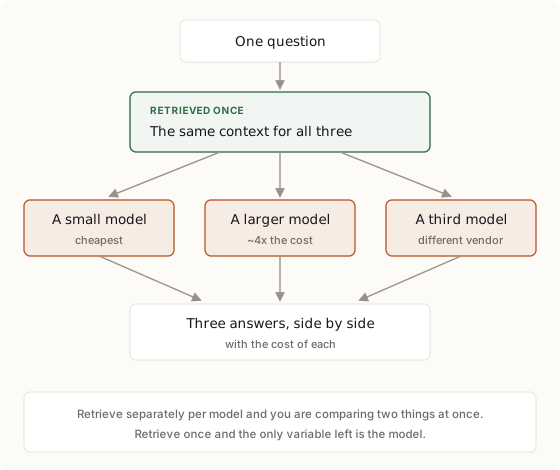
It answers a question with three different models side by side — but it retrieves the context once and fans that same context out to all three.
That sounds minor and it is the whole point. Retrieve separately per model and any difference in the answers might be the retriever, not the model. Most informal comparisons make exactly that mistake and then draw conclusions about model quality from what was actually retrieval variance.
Because the context is shared, the difference is attributable — and since the prices differ by roughly four times between the cheapest and dearest options tried, you can see what the extra spend buys on your own questions rather than on a benchmark.
The pattern, without either project
Sort your safety rules by whether their correctness must be defensible to someone outside engineering. Rules a regulator, clinician or lawyer must approve belong in code you can print. Rules that simply must never be forgotten belong in infrastructure that applies itself. Most systems need both, and most systems have only one.
| Setting | Belongs in reviewable code | Belongs in platform infrastructure |
|---|---|---|
| Healthcare | Crisis detection and the exact escalation wording | Never emit patient identifiers |
| Financial services | Suitability boundaries and mandatory disclosure text | Never emit account numbers; stay in domain |
| Legal | What constitutes advice versus information | Never emit client identifiers |
| Public sector | Eligibility determinations and appeal wording | Never emit national identifiers |
| Any assistant | The refusals you would defend in public | The redactions you would be embarrassed to have missed |
Three transfers:
Ask who has to approve the rule. If the answer is someone outside engineering, they need to be able to read it. That single question decides most of these placements.
Assume a second route will exist. Application-level protection is one new endpoint away from being bypassed by accident. If a rule must hold everywhere, put it where "everywhere" is the default.
Share the retrieval when comparing models. It costs one refactor and it is the difference between a comparison and an anecdote.
References
| Source | Event | Recording |
|---|---|---|
| Guardrails, agent runtime and managed evaluations as platform services | AWS Summit Bengaluru 2026, Apr 2026 | Keynote |
| Responsible AI for agents: walled-garden tool approval, approval thresholds | AWS Summit Bengaluru 2026, Apr 2026 | Not published |
| Safe agents: refusals do not compose across an orchestrator boundary | DataHack Summit 2026, Aug 2026 | Not published |
| Telemetry and enforcement for agent governance | Data Engineering Summit 2026, May 2026 | Not published |
| Full hall recordings across three days | CYPHER 2025, Sept 2025 | Day 2, Hall 3 |
Companion to a keyword scan in front of the model, which is the same problem solved entirely in application code.