Automating my job hunt outreach with an agent that finds, researches, and drafts — and leaves sending to me
A director/VP-level job search runs on outreach nobody automates safely, because the risky part is the send. This system automates finding, researching, and drafting end to end, and keeps the one irreversible step out of its code entirely. Underneath it, memory is split three ways: a table store for quantities, an embedding index for meaning, a graph for relationships. The question is no longer how to store data for a human to read, but how to organise it so an agent retrieves the right slice before a model call it pays for. The retrieval half gave the more surprising results: indexing each document's own title bought nearly what the vector index did, four employers' near-identical policies could only be separated by file path rather than by any retriever, and a negative result about rank fusion did not survive re-running it on a larger corpus.
44 min read
Contents
- The action kept out of the code, not just gated by review
- Two runtimes, one gate
- The gate between finding and acting
- A filter with two wide dimensions and one narrow one
- The drafting step needed a memory, and one index would have been the wrong shape
- Three representations of one business reality
- The context bill, and why a bigger model doesn't pay it
- The measured wins came from the chunks, not from a better retriever
- Four employers wrote the same policy, and no retriever could tell them apart
- An instruction in a prompt is not a mechanism
- A relationship map earns its place at the second hop
- Picking the representation is the retrieval decision
- Sensitivity belongs in a separate file, not a flag on a row
- What a version of this should measure that mine doesn't yet
- The pattern without the job search
- A reference architecture for this shape
- References
Every message this pipeline writes sits in a plain text file until someone copies it into a professional network by hand. There is no button anywhere in the code that would do that step for them instead — not a disabled one, not one hidden behind a confirmation dialog. It was never written.
I built this for a director/VP-level job search in two verticals where the seat almost never shows up as a posting — it gets created by someone reaching a founder or a hiring lead before a job req exists. So the system isn't a job-board matcher. It finds target companies, researches the right person, drafts a note worth reading, and tracks what happened, in a loop that runs once per company:
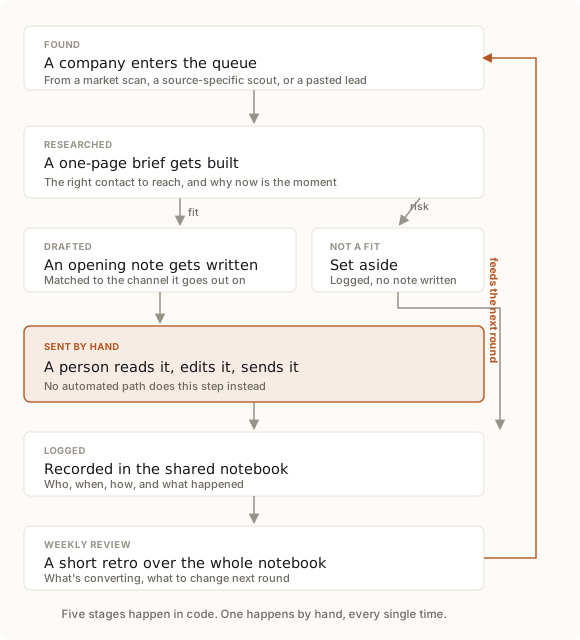
Five of those six stages run in code. Two decisions about the one stage that doesn't turned out to matter more than anything specific to the job search.
The action kept out of the code, not just gated by review
Every outbound message goes out from the sender's own logged-in session, by hand, every time. That's a stronger guarantee than "a person reviews it before it sends," because that phrasing still implies a send mechanism exists somewhere with a person standing in front of it. Here the mechanism doesn't exist. One step in the pipeline produces text and writes it to a file. A separate step logs that a message was sent, after the fact, once a person has actually sent it themselves. Neither of those, at any point, has ever had a branch that posts anything anywhere.
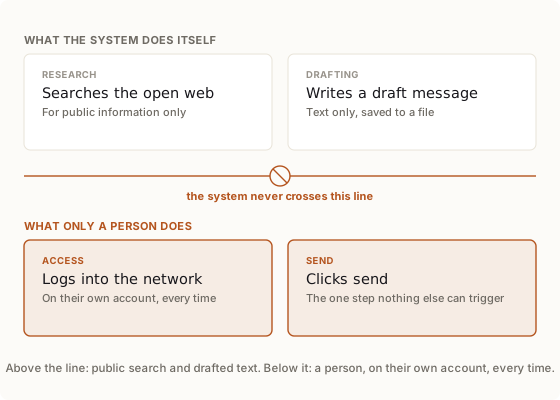
The reasoning is asymmetric risk, not caution for its own sake. A professional network account carries an identity built over years; automating a send or scraping profiles risks a suspension for a modest efficiency gain on a task run maybe a dozen times in a busy week. Compare that to something with the opposite risk shape: a research step that reads the wrong company name off a page and drafts a note for the wrong target. That's recoverable — reread the brief, redraft, nothing has left the system yet. A send is not recoverable in the same way. Whenever an action can't be undone and the cost of it going wrong is high, the fix isn't a careful gate in front of the action. It's not building the action's on-ramp into the code at all.
Two runtimes, one gate
The pipeline runs two ways, built to be equivalent rather than one being a cheap fallback for the other.
One runtime is a standalone command-line tool backed by a metered API key. Each command calls a large language model directly — grounded in live web search rather than the model's own memory of a company — and can run unattended on a schedule. This is the reference implementation: every fit-filter rule and every drafting constraint is defined here first.
The other runtime is the identical logic executed live, in conversation, by whichever coding-agent session is already paid for through a separate subscription. Instead of a script calling an API on a schedule, an agent sitting in the project does the research and drafting itself — same live web search, same fit-filter rubric — read directly from the reference implementation's own source rather than a rewritten copy of it, then hands the result to a small set of functions that only read and write the tracking sheet:
metered runtime  --  a scheduled script calling the model directly
                       |
                       |  both read the identical fit-filter and drafting rules
                       v
free runtime     --  a live agent session doing the same research and drafting
                       |
                       v
              one shared set of read/write functions over the tracking sheet
Neither runtime touches the tracking sheet with its own logic; both go through the same functions, which snapshot the sheet before every write and only ever append. That single shared gate is what keeps the two runtimes from drifting apart — a change to the fit-filter rubric takes effect in both the moment the source changes, because the free runtime is told to go read that source directly rather than follow a paraphrase of it that would go stale.
The reason to keep the metered runtime at all, given that the free one costs nothing, is that it's the only one that can be left running without a person in a chat session. Exactly one lane runs unattended for that reason — a weekly sweep that only discovers and researches, never drafts or sends. Even that lane stays on the same machine, firing as an ordinary coding-agent session on a local timer rather than moving to a hosted version of the same idea; a cloud-hosted runner was considered and ruled out for a concrete reason, not a vague one — it executes in an isolated sandbox with no access to the one file this whole system reads and writes, so it structurally can't be the thing running the sweep. The trade for staying local is a small, honest one: it only fires while the laptop happens to be on and the app happens to be open, and simply runs at next launch instead if it wasn't. Everything else stays fully on-demand, because on-demand is free and a background process can't reuse an interactive subscription's login by design, which rules out "free and also unattended" as a third option worth chasing.
The gate between finding and acting
New target companies come from public signals — a funding announcement, an executive hire, a product launch in the right space, found by search. Each one lands in a queued state and stops there. Nothing in the system promotes a queued company to an active outreach target on its own; that step is manual, every time.
This is the same principle as the send action, one step earlier and lower stakes. Getting discovery wrong costs almost nothing — a bad candidate just sits in a list, unlooked-at. Getting outreach wrong costs something real: a message to the wrong company at the wrong seniority spends a small amount of credibility that doesn't come back. So the one gate in the whole pipeline sits exactly on the boundary between "the system found something" and "the system acted on it," and nowhere else — not one step earlier, where it would slow down harmless discovery, and not one step later, where it would be too late to matter.
A filter with two wide dimensions and one narrow one
Before a queued company gets researched, three checks decide whether it's worth the time, and only one of them is strict:
| Dimension | Width | Worked example |
|---|---|---|
| Role family | Wide | A director/VP data-and-AI seat is the anchor, but a senior individual-contributor data-AI role, a product or GTM seat, a customer-facing technical role, or an investor-side role all pass. A pure sales-only seat is the only role-family miss. |
| Vertical | Wide | The two anchor verticals are voice-AI/contact-center and legal-tech/high-volume regulated intake, but any company built around a high-volume stream of customer, case, or transaction data passes too — a narrower target market on its own is context, not a disqualifier. |
| Location | Narrow | Fully remote, or one specific city, with no third option. A role that's a strong fit on every other dimension still fails outright if the only way to take it is relocating. |
The first two dimensions were widened deliberately after they started producing "risk" verdicts on companies that were obviously worth researching — the net had been excluding on adjacency (a role one step removed from the core target, a market one step narrower than the anchor vertical) rather than on an actual mismatch. Location never moved, because it's the one dimension where "close enough" genuinely isn't: either the arrangement works logistically or it doesn't, and no amount of enthusiasm on the other two dimensions changes that.
The verdict is written back into the same row the candidate already lives in, not into a separate report — a check that requires opening a second file to read is a check that quietly stops getting read.
The drafting step needed a memory, and one index would have been the wrong shape
A note that lands says something specific: a number the sender actually owned, a decision they actually made. Those live in about two hundred and eighty of my own documents — diaries, meeting notes, strategy docs — four of them running past two hundred and thirty printed pages. Finding one proof point by reading the document that holds it costs roughly a hundred and eighty thousand tokens of context. That measurement is what forced a retrieval layer.
The obvious build is one index over everything. That would have been wrong, because the questions arrive in three shapes.
Narrative questions want passages. "Why did that engagement end" has no numeric answer, and no spreadsheet anywhere records a reason.
Quantity questions want an aggregation. "How many candidates reached a final round" is a grouped count over rows, not a similarity match. Splitting a grid into text passages destroys the column structure that makes the count possible. This is the most common way a retrieval build goes wrong, and it degrades the narrative side too, because grid fragments crowd out prose in every result set.
Relationship questions want a traversal, which is the third store, further down.
So documents get sorted before anything is indexed: prose to a meaning-search index, grids to a local analytical database, and a third bucket indexed nowhere at all — source code, media, and other people's files.
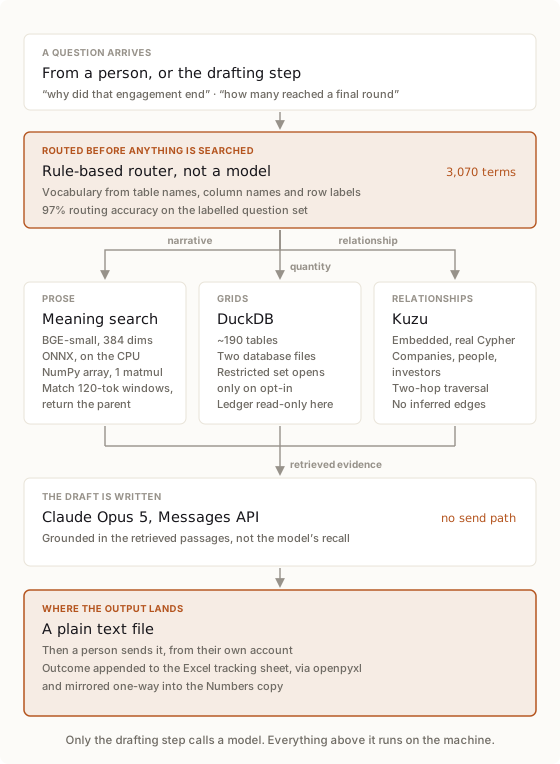
The whole layer runs without calling a model. Embeddings come from a small sentence-transformer executing locally on the processor, both databases are embedded libraries rather than services, and nothing in the layer reaches a network. Two things follow from that. It is free to re-run, diff, and unit-test, which matters because a retrieval layer nobody can re-run is a retrieval layer nobody can measure. And a personal diary sitting alongside identifiable third-party records never leaves the machine — a hosted embedding endpoint would have shipped all of it off the box in a single batch job.
The economics land in the same place. Retrieval returns roughly ten passages of a few hundred tokens each, against the hundred and eighty thousand a full document read cost. Same fact, a fraction of the context, and the index itself costs nothing per query because no metered call is involved in building or searching it.
Three representations of one business reality
The three stores are not three implementations of one idea. They are three ways of writing the same facts down, and each one makes a different question cheap.
A table keeps facts as rows and columns. This is the oldest and most mature of the three, and for anything countable nothing has displaced it. Relationships live here too — a foreign key is a relationship and a join is a traversal — so the honest claim is not that a relational store can't express a connection. It's that every additional hop costs another join, written by whoever writes the query, and that cost is what starts to bite at depth.
What a table externalises is meaning. A column has a name, a type, and perhaps a constraint. Everything else — what it counts, which population it covers, when it was last revised, whether its timestamps carry a zone — lives in documentation, a naming convention, a data dictionary, or a colleague's head. A human reading a figure applies a reflex an agent doesn't have: hang on, is this current?
I measured how hard that missing reflex bites in a separate local lakehouse project, over a public federal complaints feed. Both numbers below are measured there, not here:
- One day's delivery carried complaints spanning a median of 108 distinct event dates, and 72% of the days in the fetch window received rows across more than one delivery. One date was still receiving rows in 31 separate files. So Tuesday's count for a given day is simply lower than Friday's count for that same day. Nothing errors, no test goes red, and a correct answer quietly becomes a wrong one.
- About 4.5% of rows carried an event timestamp later than the complaint reporting it. The median negative gap is 2.8 hours, and 92% fall inside six. That isn't corruption, it's a timezone: one timestamp in the consumer's local time, the other in Eastern, and neither column declaring a zone.
The second is the more dangerous defect, because the column isn't broken. It's underspecified. An analyst sees a three-hour negative gap and thinks ah, local time. An agent reads a field typed as a timestamp, takes it at face value, and computes a calling-window figure that can be off by six hours.
Neither finding argues against relational stores. Both argue that the metadata an agent needs — units, grain, coverage, revision time, zone — has to be an output of the table rather than a convention around it. Given that, a table is the strongest of the three for anything countable: an agent reads the schema, writes a precise query, and gets back exactly the rows it asked for and nothing else.
An embedding index keeps facts as position. Prose is split into chunks, each chunk becomes a fixed-length vector, and retrieval returns the chunks nearest the embedded question. The useful property is that nearness isn't spelling. A keyword index asked for "termination" looks for that string. An embedding index also reaches passages about dismissal, ending an engagement, and offboarding, none of which contain the word.
Worth stating precisely, because the shorthand oversells it: what the index computes is proximity in a learned space, which approximates meaning rather than encoding it. Four near-identical employer policies, further down this post, are exactly where the approximation and the intent come apart — four passages that mean nearly the same thing, on a question that turned on which employer wrote them, a fact none of the four contains.
Other modalities join this store through a pipeline rather than by being poured into it. Audio becomes searchable by transcription, and it's the transcript that gets chunked and embedded. Images and video go through either a multimodal embedding model that maps them into a shared space with text, or a captioning step whose captions get embedded. The store holds vectors. What produced each vector is an upstream decision, and it sets the ceiling on what the store can answer.
A graph keeps facts as connections, with the connection itself as data. That one gets its own section below, because the terminology and the payoff both need room.
| Representation | Makes this cheap | Gets expensive at |
|---|---|---|
| Table (DuckDB) | Counting rows — "how many reached a final round" | Depth: one join per hop |
| Embedding index (BGE-small) | Recall by meaning — "why did that engagement end" | Near-duplicates that score alike |
| Graph (Kuzu) | Traversal — "which untouched company shares an investor" | Aggregation, and full-text |
The context bill, and why a bigger model doesn't pay it
Finding one proof point by reading the document that holds it cost roughly a hundred and eighty thousand tokens. Retrieval returns about ten passages of a few hundred tokens each for the same fact. That ratio is the whole case for putting a retrieval layer under a drafting step, and it's worth separating the three costs it moves, because they usually get collapsed into one.
Tokens are billed. A pipeline that hands a model the corpus and asks it to find the relevant part pays for the corpus on every question, including all of it that was irrelevant.
Long prompts are slower before they are anything. Time to first token grows with input length. A retrieval step that runs locally in milliseconds and removes most of the prompt is usually a net latency win rather than a tax on the request.
Attention isn't uniform across a long context. This is the one that gets left out, and it's why the first two don't tell the whole story. Liu and colleagues found that performance is highest when the relevant passage sits at the beginning or the end of the input, and degrades measurably when a model has to reach for it in the middle — including in models built for long contexts. So padding a prompt with the corpus isn't merely slower and dearer. It can lower answer quality, because the passage that matters is now buried among everything that came with it.
The tempting response to a pipeline that's expensive, slow, and mediocre is a stronger model. Sometimes that's right. But when the work the model is doing badly is finding rather than reasoning, a stronger model buys a better search over the same oversized haystack, at a higher price per question. The cheaper move is to hand it a smaller haystack.
That reframes what the model is for. It's the reasoning step, and the finding belongs to infrastructure specialised for it: deterministic, unit-testable, and here, free to re-run. The entire memory layer under this drafting step calls no model at all. That's precisely what makes it affordable to re-score against thirty-eight labelled questions every time the corpus moves.
There's a real trade in this, and it isn't free. Any retrieval layer can drop the passage the answer needed, where a model handed everything cannot. So the number to watch isn't average answer quality. It's the rate at which retrieval returns nothing useful for a question you know is answerable. Write the labelled question set first, measure top-ten recall against it, and treat a fall in that number as the signal to widen retrieval rather than to buy a larger model.
One framing is worth resisting. It's tempting to draw this as a maturity ladder: raw prompting, then semantic retrieval, then structured queries, then graph traversal, each superseding the last. Only the first step is a real progression — moving retrieval out of the prompt and into infrastructure is close to strictly better. What comes after isn't a ladder. Semantic, structured and relationship retrieval are siblings, each matched to a shape of question, and a system that "graduated" from its embedding index to a graph has usually just lost the ability to answer narrative questions.
The measured wins came from the chunks, not from a better retriever
Five retrieval methods, scored against thirty-eight hand-labelled questions. Thirty-eight is a configured number — the size of the question set I wrote by hand. Everything in the table is measured.
| Method | Best answer first | Answer in top ten | Mean reciprocal rank |
|---|---|---|---|
| Naive keyword match | 49% | 76% | 0.585 |
| BM25 | 51% | 78% | 0.615 |
| Dense vectors | 59% | 81% | 0.657 |
| Small-to-big (the default) | 51% | 84% | 0.654 |
| Rank fusion | 57% | 84% | 0.656 |
These are lower than the figures this post carried when it went up, where small-to-big reached 94% in the top ten rather than 84%. Both runs are real. The question set grew from thirty-two questions to thirty-eight, and the corpus roughly doubled, from about five thousand passages to eleven and a half thousand. More questions against a larger haystack is a harder test, so the drop is not a regression to chase.
It is worth stating rather than quietly restating, because a retrieval number published once tends to get quoted forever. The reason to keep scoring cheap enough to re-run is so that it gets re-run when the corpus moves underneath it.
BM25 is in that table on purpose. Comparing embeddings against naive keyword matching flatters them. BM25 needs no model, no accelerator, and no index build beyond a term-frequency table, and on a corpus dense with proper nouns it is genuinely hard to beat. An embedding index that can't beat it isn't earning its place.
Four results came out of that work. Two were negative, and one of the two has since been overturned by re-running it.
Indexing each document's own title moved keyword ranking from 0.590 to 0.671 in the original thirty-two-question run — most of what the vector index bought, for free. That pair of figures belongs to that run and has not been re-tested against the larger set; the finding is the direction, not the decimals. Several diary files state their entire subject in the filename and never repeat it in the body. A passage indexed without its title was unfindable by the obvious question about it. The instruction generalizes past this corpus: fix what sits inside the retrievable unit before reaching for a better retriever.
Anthropic's contextual-retrieval write-up arrives at the same conclusion by a more expensive route. It has a model write a short situating description for every chunk before embedding, and reports retrieval failures falling from 5.7% to 3.7% of relevant documents missing from the top twenty, and to 1.9% once keyword matching and reranking are added. Those are their measurements on their corpus, not mine. The mechanism is identical, though: the chunk was missing the context that made it findable. A filename is the cheapest available version of that context, and it is already written.
A fact buried inside a passage about something else needs the match and the return to be different sizes. One passage carries a weekly call-volume figure inside roughly five hundred tokens of process rules. No method found it in the top two hundred. The clause is a small share of the passage, so it averages into invisibility at passage-level embedding — keyword search reached it at rank thirty-three, dense search never did. Matching against windows of roughly a hundred and twenty tokens, then returning the parent passage, fixed it. On the larger question set it answers one of the two buried-fact questions where passage-level dense search answers neither. It answered both on the smaller set, so the honest version of this claim is that the technique reaches facts passage-level embedding cannot, not that it reaches all of them.
Reciprocal-rank fusion lost to its best single member twice, and then stopped losing. The mechanism is worth keeping either way: fusion rewards consensus rather than coverage. A passage only one ranker finds scores once, while anything both rankers find scores roughly double. The formula is a sum, across the rankers, of one over a constant plus the passage's rank in that ranker's list — Cormack and colleagues fixed the constant at sixty, specifically so that a single outlier ranker putting something first can't dominate the fused order. On the thirty-two-question set that arithmetic pushed both buried-fact answers out of the fused top ten, which read as a clean negative result.
On the current set fusion ties small-to-big at 84% in the top ten and recovers the buried-fact question that passage-level dense search misses. So the verdict is withdrawn while the mechanism stands. Small-to-big remains the default because it is the simpler of two methods scoring the same, which is a weaker and more accurate reason than the one I had.
That reversal is the more useful lesson than either measurement. A negative result held on a thirty-two-question set at one corpus size, and did not survive the corpus growing. Retrieval verdicts have a shelf life, and the arithmetic that explains a result is more durable than the ranking it produced.
Abstaining on a low score didn't work. Both term coverage and vector similarity were tried as a confidence threshold. Every threshold that silenced a wrong answer silenced real ones too. Weak matches now carry a label instead of being withheld. If you're building this, measure a candidate threshold against your own true positives before shipping it — the intuition that a confidence floor is free is the thing to check, not assume.
Four employers wrote the same policy, and no retriever could tell them apart
A question arrived that looked trivial: what was the leave policy at the company I worked at during a particular stretch. The system answered confidently and returned a different employer's policy.
Four former employers each wrote an office policy, a leave policy and a contractor policy. The documents are near-identical in wording, because that is how such documents get written. Twenty working days of annual leave, ten days of sick leave, a clause about public holidays not counting against the balance. All four say roughly that.
Retrieval matches on wording. So it returned all four, ranked by nothing that mattered. The employer actually being asked about came sixteenth under keyword matching and twenty-fifth under dense vectors. The default returns five results.
Two things about that are worth separating. The first is that the answer was wrong. The second is that nothing in the output said so — every returned passage was a genuine leave policy, scoring exactly as a good match should score. This is the failure mode that matters in a drafting pipeline: not an empty result, but a plausible one from the wrong source.
A better retriever cannot fix this, and it is worth checking rather than assuming. The smarter method ranked the right employer worse than the crude one, twenty-fifth against sixteenth. That is the signal that the problem is not ranking quality. The information needed to separate four near-identical documents was never in their text. Nobody writes "this is the policy of the company you worked at from this year to that year" inside the policy.
It was in the file path the whole time. Exported document folders carry per-account directory names, and folder and file names carry company names. So documents now get an organisation label derived from where they sit rather than what they say, and a query can be scoped to one. The right employer's three policy passages come back at the top, in place of three other employers'.
Two design choices in that are transferable, and one bug is worth the space.
A document gets a set of labels, not one. One contractor policy sits in a second company's folder inside a third company's export directory. All three facts are true. An earlier instinct was to score the candidates and keep a winner, which would have discarded the label that makes the document findable at all. Where provenance is genuinely multi-valued, storing it as a set costs nothing and forcing a single value silently loses data.
The label describes where a document sits, not what it discusses. A meeting note filed under one company that talks at length about another is labelled by where it lives. That is a real limitation and the right trade. Labelling by content would match every document that so much as mentions a company, which is the problem being solved rather than a solution to it. Provenance is a property of the artifact; subject matter is a property of the text, and conflating them gives you back the original mess.
The bug is the kind that hides in plain sight. The machine's own user account is named after one of the companies, so every absolute path in the corpus contains that company's name. The first version of the matcher labelled all one thousand three hundred and sixty-six documents as belonging to that employer, instead of the seventeen that do. It looked like it worked, because a filter that matches everything returns plausible results for every query.
The fix is to strip the machine-specific prefix before matching anything, and the durable version of the fix is a test that fails if that ever stops happening. The general shape: when deriving metadata from a path, the parts of a path that describe the machine are not data about the document, and they are easy to leave in because they are invisible in every example you look at.
An instruction in a prompt is not a mechanism
The rule "numbers come from the spreadsheet, never from prose" was written down plainly, in the instructions the drafting agent reads. It was still wrong in practice. A keyword search returned a paraphrase of an operational rate, lifted out of a process document — and that paraphrase understated real weekly volume by a factor of three. A stale restatement reaching a draft is the concrete harm here, not a hypothetical one.
The fix was a classifier in front of the search, deciding which store answers before anything is retrieved. Quantity phrasings route to the analytical database. Narrative phrasings route to the passage index. Some questions need both, and get both.
It is rule-based rather than a model, deliberately. Routing here is a small closed problem, and a model classifier would be non-deterministic across runs, awkward to unit-test, and would make the one layer that calls no model depend on one. Its accuracy is scored alongside retrieval: 97% on the question set, and twelve of fourteen held-out phrasings. Both misses routed to the database when prose was the right answer, which is the safe direction to fail in.
One detail decided whether it worked at all. The routing vocabulary is built at load time from table names, column names and row labels — three thousand and seventy terms in total. Table names alone were too weak. The table holding an automation rate has neither "automation" nor "rate" anywhere in its name; those words exist only as cell values inside it.
A relationship map earns its place at the second hop
The third store answers one question the other two handle badly: which company I haven't approached shares an investor with one where someone already replied.
Three terms carry the whole model, and they're worth naming precisely. A node is an entity — here a company, a person, or an investor. An edge is a named, directed relationship between two nodes: backed by, employs, invested in. In a property graph, which is what this store implements, both nodes and edges carry their own properties. A company node holds a vertical and a funding stage; the edge to its investor holds the round and the date it was announced. Attributes on the relationship are the part people miss, and they're model-specific: in an RDF triple store an edge is a bare triple, and giving it attributes of its own takes reification.
Traversal is what you do with that. Start at a node you can name, follow an edge type, arrive at another node, read its properties, and keep going while the relationships stay relevant. What comes back is a connected set of facts, not a ranked list of passages.
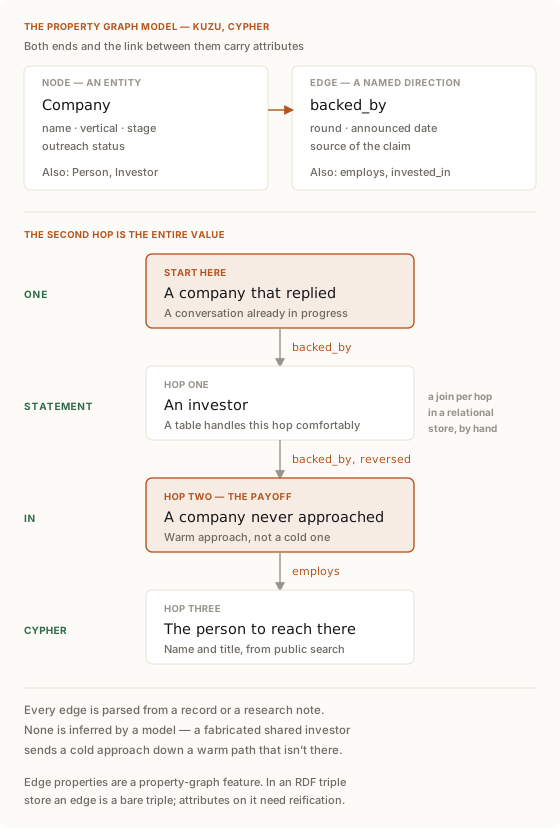
A table manages the first hop comfortably — list the investors in a given company. The second hop is where it turns awkward, and the second hop is the entire value. An untouched target connected through a shared backer to a conversation already in progress is a warm approach rather than a cold one, and that reframes a long backlog as a ranked shortlist. So companies, people and investors live in an embedded graph database, queried in a graph query language, where that traversal is a single statement.
The reason to check this rather than assume it is that the failure mode of asking an embedding index a relationship question isn't an empty result. I built a separate public project to make that concrete, on a synthetic matchmaking network where the facts worth having are all chains: a match, a timed handoff, a trust event, a replacement. Asked why one person's handoff with one specific counterparty went quiet, the vector path did the only thing it can. It embedded the question and returned the profiles that read most similarly. None of them belonged to the counterparty in the question. Nothing errored, no score collapsed, and nothing in the output said the real answer needed a specific set of edges walked instead. The graph path walked them and returned the expired deadline, the trust movement, and the replacement that followed.
The same model narrated both. The difference was entirely in which facts it was handed — which is the argument of this whole post in one experiment: retrieval architecture, not model choice, decides whether "why" questions are answerable at all.
Every edge comes from deterministic extraction — parsed fields and written research notes, never inference. That's a correctness requirement rather than a shortcut. A fabricated shared investor routes outreach down a warm-intro path that doesn't exist, and a warm approach that turns out to be cold is worse than no suggestion at all.
That's a real divergence from how graph retrieval is often built. Microsoft's GraphRAG names the same limitation in ordinary vector retrieval — it "struggles to connect the dots" across facts linked only by a shared attribute — and then builds its graph by having a model read the corpus and extract the entities and relationships it finds. That's the right trade when the relationships exist only in prose and no structured record of them exists. It's the wrong trade here, because a structured record already exists and the cost of a wrong edge is asymmetric. A hallucinated shared investor doesn't degrade an answer slightly. It manufactures a warm introduction that was never there.
Two rules keep it honest, and the second is the one worth copying.
Company names in written research notes carry forms the tracking sheet doesn't: a parenthetical legal name, two names joined by a slash, a trailing corporate suffix. Matching on the literal string alone dropped eight companies' investor and contact data silently. Lookup now tries a series of derived keys, most specific first.
And when a research note's company still matches nothing in the tracking sheet, the note is recorded as unmatched and skipped — no node is created for it. The tracking sheet defines what exists. Inventing a company from a near-miss name would split one company's edges across two nodes, and a traversal over a split node returns answers that are confident and wrong.
Picking the representation is the retrieval decision
The three stores have been described one at a time, which understates the interesting part. The routing layer's job isn't to pick a favourite. It's to read the shape of a question and send it where that shape is cheap.
| Question | Where it goes | Because |
|---|---|---|
| "How many candidates reached a final round?" | The table store | A grouped count over rows; no passage contains the answer |
| "Why did that engagement end?" | The embedding index | A reason recorded in prose, which no column holds |
| "Which untouched company shares an investor with one that replied?" | The graph | Two hops, where a table needs a join per hop |
| "Is this company worth approaching, and through whom?" | All three | It decomposes into a count, a proof point, and a traversal |
The fourth row is the one that matters architecturally, because it's the common case for anything worth calling an agent. A question that decomposes doesn't want a router that picks one store. It wants the sub-questions dispatched separately, the results assembled, and each fact labelled with where it came from before any of it reaches a model.
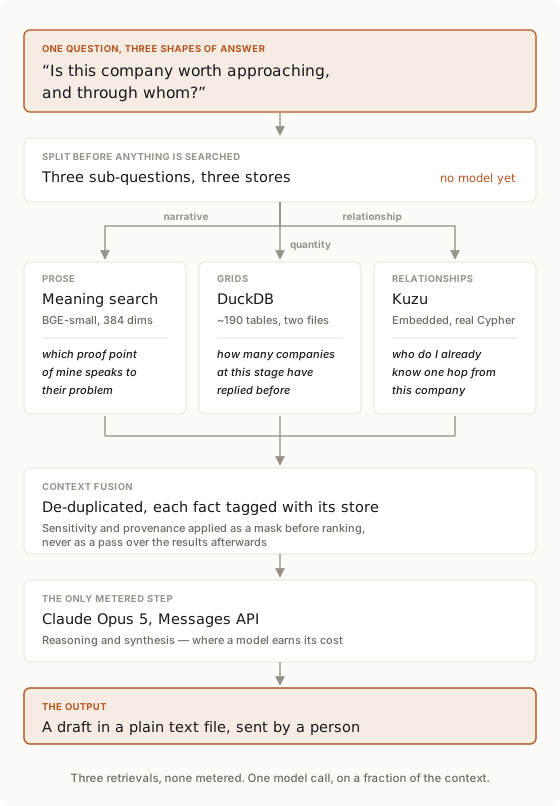
The word "fusion" covers two different operations, and conflating them is how this step gets built wrong. Combining two ranked lists over the same corpus is rank fusion in the technical sense, and the arithmetic above applies: shared rank positions, one relevance scale, a defensible combined order. That's what happens here between the keyword and dense rankers over the same passages.
Combining a count from a table, a passage from an index, and a path from a graph is not that. There's no shared relevance scale between a number and a paragraph, and no meaningful way to rank one against the other. What that step actually does is assemble and label: keep every fact, record which store produced it, and hand the model a context where the provenance of each claim is explicit. Calling it fusion is fine. Implementing it as though the three results were comparable scores is not.
Each store is also weakest at what another is best at, and the graph is the clearest case. Asked how many candidates reached a final round, it would have to walk every matching path and count what it landed on — a grouped count performed the expensive way, over a structure built for depth rather than breadth. That's the same question the table store answers in one statement. Neither of them is badly built; they're shaped for different questions.
So the three are complementary in a specific sense rather than a diplomatic one. They aren't competing implementations with a winner pending. They're different projections of one business reality, and the projection that makes a question cheap is a property of the question, not of the technology.
Sensitivity belongs in a separate file, not a flag on a row
The corpus holds three kinds of material: professional content, my own private life, and identifiable third parties who never agreed to sit in a search index. Which of the three a document is has nothing to do with which store it lands in, and it gets enforced when a query runs rather than by convention.
Five of the workbooks are hiring pipelines keyed to real people's names. They are legitimately my own business records, so they load — into a separate database file, attached only on an explicit opt-in. A sensitivity column in the shared database would have been easier to build, and it would have meant every future query had to remember the filter. A separate file keeps those rows outside the default query path altogether. A convention is something you remember; a boundary is something you can't forget.
The drafting path filters harder still, to professional material only. A proof-point search running unfiltered will eventually surface a compensation figure into a draft's context — mine, or a job candidate's.
Some categories are excluded unconditionally, with no setting that re-enables them:
- Financial and identity documents.
- Third-party HR material.
- The folder a form-hosting service creates for uploaded files. That one held a couple of hundred named applicants' CVs, submitted against an internship posting — other people's documents, gathered for a purpose that wasn't this one.
Scope is a preference a later rebuild can revisit. Those aren't.
One more finding, from getting it wrong first. Judging a folder by its name doesn't work. A folder of a hundred and eleven files looked like venture history and turned out to be a hundred and two monthly invoices wrapped around four documents that mattered. Relevance is now scored on each document's own opening words, against probes describing what a relevant document looks like and probes describing what an irrelevant one looks like. Both directions are needed: a household-finances document and a profitability memo both talk about money, and only the negative probes separate them. The output is a ranked report a person adjudicates, not a decision — and the middle bucket is the point, because that is exactly where a name-based guess picks wrong without saying so.
What a version of this should measure that mine doesn't yet
The tracking sheet is append-only: recording that a contact replied, or that an outcome changed, is always a new row, never an edit to an old one. That was a deliberate choice to avoid the fragility of matching and rewriting an existing row by hand, and it has one direct cost — "what's the current state of this thread" is a small aggregation over rows computed on demand, not a single field you can glance at. If you're adapting this shape: don't reach for update-in-place until row-matching has actually caused a real bug, and budget for building that aggregation once you have enough rows that scanning them by eye stops working.
The research step behind all of this is grounded entirely in public web search, deliberately, to stay off a professional network's logged-in session entirely — which means it works from name-and-title snippets, not a full profile read. If you're building something similar and considering a deeper, authenticated research step: don't add it speculatively. Add it once you can point at evidence that shallow search-based research, and not sending capacity, is the actual bottleneck slowing the pipeline down — and track how often a drafted note gets rewritten by hand before sending as the signal that tells you when that's true.
The pattern without the job search
Strip the domain and two patterns are left. An outbound pipeline where the one irreversible action has no code path at all, and where the same research-and-drafting logic runs on either a metered, unattended execution path or a free, supervised one, as long as both write through the same gate. And underneath it: a private memory that routes a question to the store holding that shape of answer, rather than instructing a model to prefer one source over another.
Both generalize well past a job search:
| Context | The irreversible action kept out of code | Where its own records answer better than a model's recall |
|---|---|---|
| Sales development | Sending the outbound email or connection request | Won-deal notes, for the proof point that actually moved a buyer like this one |
| Recruiting outreach | Messaging a candidate on a professional network | Prior placement records, for which pitch converted this role family before |
| Vendor and partner outreach | Committing to terms in a written reply | Past contract terms, for what was already conceded and shouldn't be reoffered |
| Fundraising outreach | Sending a cold note to an investor | The company's own metric history, so a figure in a deck traces to a source |
| Customer win-back or renewal | Sending the actual retention offer | Support and usage history, for why this particular account actually lapsed |
| Press and media outreach | Pitching a journalist directly | Past coverage, for what this outlet has already run and won't run twice |
Three pieces transfer directly:
Keep the irreversible action out of the code entirely, not just behind a review step. A review step is a person supervising a mechanism that still exists; removing the mechanism means there's nothing left for an error, a prompt-injection attempt, or a future refactor to accidentally trigger. The difference only shows up the day something tries to use that path — and on that day, "the code can't do it" beats "the code isn't supposed to do it." Put that boundary at the highest-stakes single step and no earlier. Gating discovery instead of the send would slow the cheap, recoverable part of the pipeline for no safety benefit, because a wrong discovery costs nothing to unwind. The gate belongs exactly where getting it wrong stops being free.
Give the same logic two execution paths sharing one write gate, instead of building "the cheap version" as a separate, drifting implementation. The free path here is cheap specifically because it's told to read the paid path's own rules as its instructions, not a summary of them, and because both write through identical, snapshotted, append-only functions. Two implementations of the same judgment call will disagree eventually; one source of truth read two different ways won't.
Match the store to the shape of the question, and make that choice in infrastructure rather than in a prompt. Writing "numbers come from the spreadsheet, never from prose" into a model's instructions did not stop a paraphrased rate from reaching a draft. A rule-based classifier in front of the search did, because it decides before anything is retrieved rather than hoping afterwards. Scaled up, that same instruction is an architecture: a count belongs in a table, a reason belongs in an index over prose, a two-hop connection belongs in a graph, and the fix for a pipeline that's slow, expensive and mediocre is usually a smaller, better-labelled context rather than a larger model. Exhaust the cheap fixes to what sits inside the retrievable unit first — a document's own title indexed alongside its passages, a smaller window to match against than the one you return — because those cost nothing and they close most of the gap.
A reference architecture for this shape
For anyone building the same pattern: a spreadsheet or lightweight database as the single source of truth, read and written through one small set of functions that snapshot before every write and only append; a research step grounded in live web search rather than a model's own memory, so every claim traces back to something fetched, not recalled; a fit filter computed inside that same research call rather than as a separate pass, with its verdict written into the same row it judges; a drafting step that reads a small, human-curated file of confirmed-good examples before writing anything new; zero code path for the one irreversible action, with a logging step that only ever runs after a human confirms it happened; and exactly one scheduled lane, kept to the smallest slice of the pipeline that actually benefits from running unattended.
The memory layer under the drafting step is three local stores and a router in front of them, all of it model-free. Narrative passages go through a small sentence-transformer — a 384-dimension BGE model executed on the processor via ONNX, cached to a plain array file and searched by one matrix multiply, because at this corpus size a specialized vector index adds operational surface for no measurable latency. Spreadsheets go into DuckDB, with third-party material in a second database file attached only on request. Companies, people and investors go into Kuzu, an embedded graph database with real Cypher, so a two-hop shared-investor traversal is one statement. In front of all three sits a rule-based router, scored on the same question set as retrieval itself.
Retrieval carries two independent filter dimensions, and both are applied as a mask before ranking rather than as a pass over the results afterwards. One is sensitivity, which keeps private and third-party material out of the drafting path. The other is provenance, derived from each document's own file path, which is what separates four employers' near-identical policies. Filtering before the cutoff rather than after is the detail worth copying: filter afterwards and an excluded passage still consumes one of the slots you asked for, so a query for five results quietly returns four.
The pieces worth getting right from day one, because they're expensive to retrofit: writing the fit verdict into the same row as the candidate rather than a side report (moving it later means touching every consumer of that report); choosing append-only before there's enough volume to justify anything else (retrofitting update-in-place onto a sheet already full of rows means writing a matching layer you didn't need to design under pressure); building the free runtime to read the paid runtime's rules directly from day one, rather than hand-copying them once and letting the copy drift; and writing the labelled question set before the retrieval layer rather than after, because every choice above it — chunk size, whether to index titles, whether fusion helps — is unarguable without it.
The through-line, if there's one worth keeping past the job search: none of this was a choice between a table, an index and a graph. It was the same business reality written down three times, in three shapes, because the shape that makes a question cheap belongs to the question rather than to the technology. Structured facts stay structured. Prose stays searchable by meaning. Relationships become something you can walk. A router picks, only the relevant slice travels, and the model is left doing the part it's genuinely best at — reasoning over a small, well-labelled context. What that buys is unusual in moving four ways at once: less context, lower latency, a smaller bill, and better answers, because the passage that mattered is no longer competing with the corpus it arrived in.
References
Papers
- Cormack, Clarke and Büttcher, Reciprocal Rank Fusion outperforms Condorcet and individual Rank Learning Methods, SIGIR '09 — the source of the fusion arithmetic used here, including the constant of sixty and the reason for it. PDF
- Liu, Lin, Hewitt, Paranjape, Bevilacqua, Petroni and Liang, Lost in the Middle: How Language Models Use Long Contexts, 2023 — the finding behind the attention argument above. arXiv:2307.03172
Engineering write-ups
- Anthropic, Introducing Contextual Retrieval — prepending a model-written situating description to each chunk before embedding, and the failure-rate reductions quoted above, which are theirs and not mine. anthropic.com
- Microsoft Research, GraphRAG: Unlocking LLM discovery on narrative private data — names the same limitation in ordinary vector retrieval, and builds its graph by model-driven extraction rather than deterministically. microsoft.com