Min-cost max-flow picks the match, and the confidence multiplier that keeps an unproven claim at 30% of its weight
A generative model cannot be regression-tested, cannot explain a specific past output, and cannot be told apart from its own drift — which makes it the wrong thing to put in charge of who two people meet. So the models here read evidence and write messages, and a weighted dot product plus a flow solve makes the actual call. The payoff is that any ranking can be re-derived exactly by changing one input and running it again.
12 min read
Contents
Every night a batch job decides who meets whom. It loads the active pool, scores every viable pairing, and commits the matches.
There is no LLM anywhere in that decision.
That surprises people, because riteangle is an agentic product end to end. There is an assistant that coaches you, a proxy agent that messages on your behalf, a generation step for every opener. But at the point where the system decides who you actually meet, the model is out of the loop and the answer comes from arithmetic.
Probabilistic edges, deterministic core
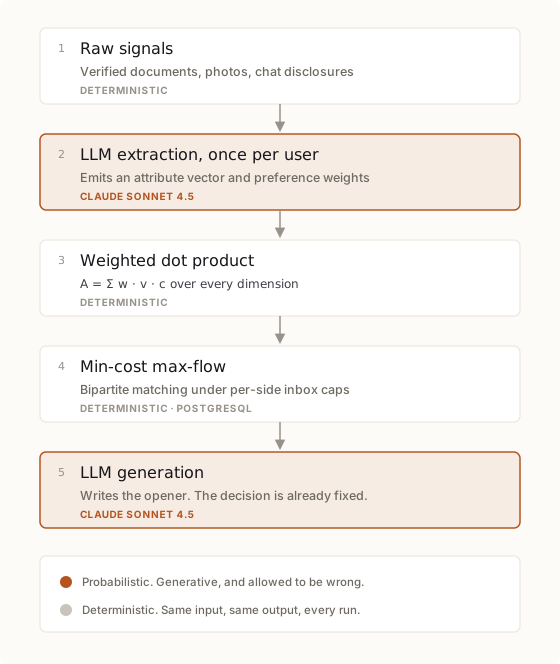
The LLM appears twice, at both ends, and never in between.
At ingestion it does what LLMs are genuinely good at: reading unstructured human material — an uploaded payslip, a profile, a chat transcript — and emitting structured estimates. It runs once per user, not once per pair, and its output is cached. At generation it does the other thing LLMs are good at, which is writing something a person will actually read.
Everything between those two points is a closed-form computation.
Three vectors
Each user carries three vectors over a fixed taxonomy of dimensions — health, career, financial, and so on. Nine open dimensions, plus four sensitive ones that are excluded from any global ranking and only ever used in a pairwise context.
| Vector | Meaning | Range | Source |
|---|---|---|---|
| v — attributes | Claimed level on each dimension | 0–100 | LLM extraction |
| c — confidence | How corroborated that claim is | 0.3–1.0 | Verified proofs only. Never the LLM |
| w — preference weights | How much this user cares about each dimension | sums to 1 | LLM extraction, or set explicitly by the user |
Appeal of a candidate to an evaluator is a weighted dot product across the taxonomy:
A(m → f)  =  Σ  w[f,d] · v[m,d] · c[m,d]
             d
Because the weights are normalised and confidence is bounded above by 1, the result stays on a 0–100 scale without clamping tricks.
Edge value is the geometric mean of the two directional appeals:
value(m, f) = √( A(m → f) · A(f → m) )The geometric mean rather than the arithmetic one, deliberately — it punishes asymmetry. A pairing where one side scores 90 and the other 20 lands at 42, not 55. Lopsided enthusiasm is not a match, and the maths should say so.
Assignment is then a min-cost max-flow solve over the bipartite graph, with per-side capacities acting as inbox caps rather than per-run quotas. That distinction cost us: an earlier version applied caps per run, so a nightly solve starting from a blank slate would hand out a full allocation on top of everything already sitting in someone's inbox. Women hit 21 active matches against a cap of 12 before we caught it.
The one number the model never writes
This is the load-bearing constraint in the whole design.
An LLM will happily assign a high attribute score from a confident-sounding profile. That is fine — v is a claim, and claims are cheap. What stops the claim from propagating into the ranking is c, which is derived exclusively from the verification record: proof categories completed, documents checked, artifacts corroborated. It floors at 0.3 and only approaches 1.0 as real evidence lands.
| v (claimed) | c (confidence) | Effective contribution | |
|---|---|---|---|
| Asserted, unproven | 90 | 0.3 | 27 |
| Asserted, verified | 90 | 1.0 | 90 |
Identical claim, identical LLM output, 3.3× the weight — purely as a function of evidence.
Income goes further still. A stated salary is not scored by the LLM at all; it runs through a fixed logarithmic curve normalised against cost-of-living by city tier. It is the dimension people most reliably inflate and the one we can most cheaply verify, so the model gets no vote.
Five teams reached the same conclusion
I did not reason my way to this. Over two years at India's data and AI conferences — the Data Engineering Summit, DataHack Summit, MLDS and others — the same architectural claim kept surfacing from organisations with nothing in common.
| Organisation | Event | The claim |
|---|---|---|
| Everpure | DataHack Summit 2026 | 40+ PB of live telemetry, tables past 250B rows. The LLM is structurally barred from raw data. It emits a declarative plan, compiled to a topologically sorted DAG and executed at zero token burn; a small model does final synthesis only |
| INDmoney | Data Engineering Summit 2026 | Telemetry feeds LLM agents for predictive silent-failure detection — but the action is deterministic: open a ticket, block the PR, apply the fix |
| Novartis | Data Engineering Summit 2026 | A multi-agent swarm over a zero-copy fabric, coordinated by a deterministic knowledge graph rather than an orchestrator agent, with cryptographically signed reasoning traces for continuous GxP |
| Millennium | MLDS 2026 | Stated it flatly: constraints beat cleverness. Use the model for reasoning, not for rule enforcement. Immutable audit trails, human-in-the-loop measured by edit distance trending down |
| BITS Pilani | MLDS 2026 | A quantified structure-over-policy argument, benchmarking a structured solver against multi-agent RL, OR-Tools and GNNs on a routing problem — presented on an agentic-AI stage |
A hedge fund, a pharma company, a fintech, an infrastructure team and an academic lab. Different domains, different constraints, same conclusion: let the model reason, don't let it enforce.
The failure mode they are all avoiding is the same one. A generative model in an enforcement path is non-reproducible by construction — you cannot regression-test it, you cannot explain a specific output after the fact, and you cannot tell a drift from a prompt change. Put it at the edges and those problems stay at the edges.
The feedback loop we refused to close
There is a progress indicator in the app, derived from a man's score, shown to the woman he is matched with.
We had to write a rule into the codebase to stop ourselves connecting it back.
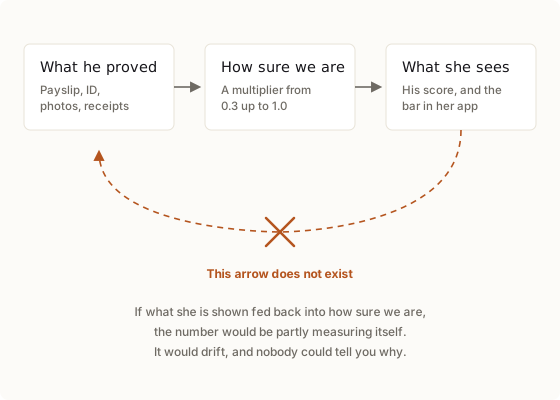
The temptation is obvious. Engagement against a high bar is signal, and signal is useful. But the moment a displayed artifact feeds back into the confidence weighting that produced it, the metric is partly measuring its own prior output. It drifts, slowly, and no one can attribute the drift afterwards.
So two rules are written into the code in capitals.
The first: this indicator never feeds trust or match scoring. The second: the hand-off gate may read a score to decide what to show, but nothing about what was shown ever propagates back into scoring.
Both exist because at some point somebody — me — was about to close the loop, and had to be argued out of it in writing.
Second-order effects in a ranking system are not a bug you find in testing. They are a bug you find six months later when the numbers stop meaning what the documentation says they mean.
Where we break our own rule
I would rather state this than have someone find it.
Everything above describes the nightly batch. It does not describe the on-demand path.
There is a "find matches now" button. Pressing it runs an LLM over the candidate set, scores each pairing 0–100, and commits anything above 50 as a real match. That is an LLM making a matching decision — precisely the thing this post argues against.
It is bounded: a small lifetime quota per account, fifty candidates per run. It exists because a nightly job is nightly, and a member who joins at 10am should not stare at an empty inbox until 2am. It is still the weakest component in the system.
There is a quieter defect too. The solver carries an assortative term meant to discourage pairing across very different profile-strength bands, and it reads a field that is only populated by an admin-triggered shadow scoring pass. In practice that field is zero for most users, so the term contributes nothing — and worse, it is partially populated, so the penalty fires asymmetrically against exactly the users who were shadow-scored. A tuning parameter that appears active and is inert is worse than no parameter, so it is getting wired up or removed.
The pattern, without the dating app
Nothing here is specific to matching people. Strip the domain and it is:
A deterministic decision core with generative models at the boundaries. A model converts unstructured evidence into structured, cached features. A closed-form function ranks. A solver assigns under constraints. A model writes the human-facing explanation after the decision is fixed. Confidence in any feature is derived from corroboration, never asserted by the model that proposed it.
This is the right shape for any decision that is consequential, contested, or regulated — that is, any decision someone might demand you justify.
| Industry | The decision | What the confidence term becomes |
|---|---|---|
| Lending and credit | Approve, price, set a limit | Which income and liability claims are documented versus stated |
| Insurance underwriting | Accept, rate, exclude | Which risk factors are inspected or verified versus self-reported |
| Recruiting and staffing | Shortlist and rank candidates | Which skills are evidenced by work samples or references versus claimed on a CV |
| Supply chain and logistics | Assign loads to carriers | Which capacity and compliance attributes are audited versus declared |
| Clinical triage | Prioritise a queue | Which findings are instrumented versus reported by the patient |
| Grants, admissions, procurement | Award a scarce slot | Which applicant claims carry supporting documentation |
Four pieces transfer directly:
Run extraction once per entity, not once per pair. The model reads a person, a supplier or an applicant a single time and its output is cached. Scoring then runs over cached features. This is what makes the system affordable at n² comparisons — the model cost scales with the number of entities, while the arithmetic scales with the number of pairs.
Separate the claim from its corroboration. Keep "what is asserted" and "how well is it evidenced" as two different numbers that multiply.
Collapsing them into a single score is the most common way ranking systems become unauditable. Keeping them apart is why an unproven claim here keeps 30% of its weight — not all of it, and not none of it.
Make assignment a constrained solve, not a threshold. Anything with capacity on both sides — reviewers to papers, jobs to machines, cases to caseworkers, candidates to interview slots — is a flow problem. Thresholding each pair independently overfills the popular side, which is exactly the failure this system had before caps were bound to the recipient rather than the run.
Keep displayed artifacts out of the scoring inputs. Any indicator you surface to a user must not feed back into the model that produced it, or the metric starts measuring its own history. This is the same discipline as holding out a validation set, applied to a live product surface.
The trade you are accepting is the same one every time: a closed-form ranker only knows the features you defined, so it will never surprise you the way a model reading raw evidence might. What you get is the ability to answer why this ranking, and what would change it — exactly, by re-running the function with one input altered.
What this costs us
The honest trade-off: this architecture is worse at serendipity.
An LLM reading two full profiles can notice something oblique and charming that no dimension in my taxonomy encodes. A weighted dot product will never find that. It only knows the dimensions I thought to define, weighted the way users said they wanted them weighted. Every ranking system inherits the blind spots of its feature set, and mine are hard-coded.
What I get back is counterfactual explainability. Because scoring is a pure function, I can re-run it with one input changed and get an exact answer: proving this specific claim moves this man from fourth to second in this woman's ranking. Not a plausible-sounding rationalisation — the actual recomputed result.
You cannot do that with a model's opinion. And when the output of the system is who someone spends their Saturday with, being able to show the working matters more than being occasionally delightful.
References
Most of these talks have no published recording. Indian AI conferences tend to livestream entire halls rather than publish individual sessions, and two of the 2026 events published nothing beyond a teaser. Where a recording exists it is linked.
| Source | Event | Recording |
|---|---|---|
| Everpure — deterministic execution layer, zero token burn | DataHack Summit 2026, Bengaluru, Aug 2026 | Not published |
| INDmoney — deterministic action from probabilistic detection | Data Engineering Summit 2026, May 2026 | Not published |
| Novartis — deterministic coordination of an agent swarm | Data Engineering Summit 2026, May 2026 | Not published |
| Millennium — trust in an agent when stakes are real | MLDS 2026, Mar 2026 | Not published |
| BITS Pilani — structure over learned policy | MLDS 2026, Mar 2026 | Not published |
| Full hall recordings, several relevant sessions | CYPHER 2025, Sept 2025 | Day 2, Hall 3 · Day 3, Hall 3 |
| Building real agentic systems — Alessandro Romano | DataHack Summit 2025 | Recording |
| Agentic knowledge-augmented generation — Arun Prakash Asokan | DataHack Summit 2025 | Recording |
First of nine posts on riteangle's architecture. Next: cross-thread agent memory without cross-user leakage — a shared memory store deliberately built with no column recording where any of its rows came from.