Cross-thread agent memory with provenance omitted at schema level, so shared recall cannot leak its source
When one person is represented by several agents, each working for a different counterparty, he answers the same question over and over — and the obvious fix, shared memory, quietly tells each agent about conversations it was never part of. The value and the hazard come from the same fact. This is a memory store where the origin of a row was never recorded in the first place, so it cannot be recovered by a query, an agent, or anyone with database access.
12 min read
Contents
- Long-term memory is the part you own
- The privacy boundary is a missing column
- Writes are unconditional, reads are gated
- The verbatim gate
- A stale fact is a correctness bug
- Both agents have to agree what a topic is
- How this compares to the industry
- The pattern, without the dating app
- What this deliberately does not do
- References
A man matched with three women has three separate agents talking to him. Each one is working on behalf of a different person, and each one, quite reasonably, wants to know whether he wants children.
So he gets asked three times.
That is a bad experience, and it is also a bad signal — by the third time he is answering a form, not having a conversation. The obvious fix is shared memory: let the third agent see what he told the first. The obvious fix is also a cross-user data leak, because the moment an agent can quote something he said in another thread, it has told him something about a conversation he did not have with it.
The answer ledger is our attempt to get the first thing without the second.
Long-term memory is the part you own
The framing that made this tractable came from an AWS session at their Bengaluru summit that split agent memory into six types across two lifetimes.
The argument that stuck was about ownership. Short-term memory belongs to whichever framework you picked, and you have limited control over it. Long-term memory is retrieved from stores you own. Which makes data quality, not model quality, the deciding variable.
A talk at DataHack Summit 2026 put it more bluntly still. The session was called The Memory is the Harness, and its closing line was that memory is your only true moat.
If long-term memory is the part you actually own, then its schema is a product decision, not a storage detail. Which is where this gets interesting.
The privacy boundary is a missing column
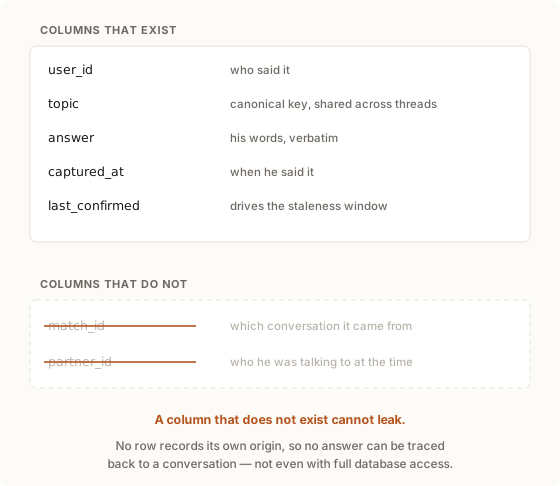
The ledger stores what he said and the topic he said it about. It does not store which conversation it came from, or who he was talking to.
Not "does not expose." Does not store.
There is no match identifier on the row, and no counterparty identifier. The origin cannot be reconstructed from the table at all — not by a query, not by an agent, and not by someone with full database access and bad intentions.
This is a deliberately crude mechanism, and crude is the point. Access control that depends on every future query being written correctly is one refactor away from failing. A column that was never created cannot be selected by accident.
The cost is real: we cannot answer "where did this come from" for our own debugging either. That was the trade, and we took it.
Writes are unconditional, reads are gated
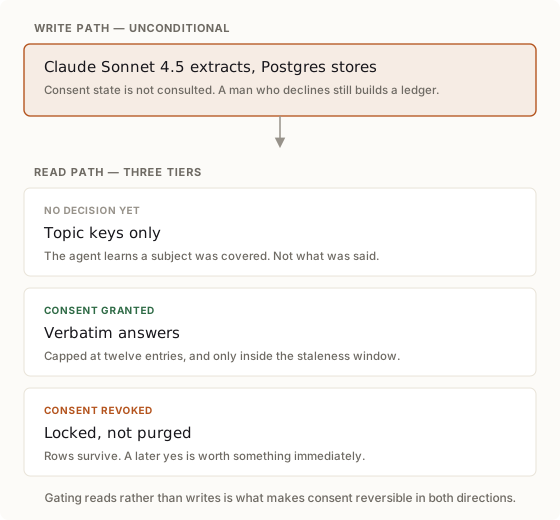
Consent gates reading, never writing.
That asymmetry is the bit people push back on, so it is worth defending. If declining stopped the capture, then a man who says no in month one and yes in month three starts from nothing, and his yes is worth nothing for another three months. Gating the read instead means consent is instantly meaningful in both directions — granting it makes existing memory usable immediately, revoking it locks the store without destroying it. Revocation is a lock, not a purge.
The middle tier is the part I am most pleased with. Before any consent decision exists, an agent can read topic keys but not answers. It can see that "kids" has been covered before, without seeing what was said.
That sounds like a technicality. It is actually the whole feature. It lets the agent make an informed decision about whether asking is worth a turn — if the subject is already answered somewhere, maybe spend the turn on something else — without any content crossing between threads. The cheapest possible signal, and it turns out to be the one that matters.
The verbatim gate
Anything entering the ledger has to survive one check: the extracted answer must appear literally in what he typed. Not paraphrased, not summarised, not "semantically equivalent." A substring match, or it is discarded.
This is a hard constraint on an extraction model that would much rather be helpful, and it throws away perfectly good captures.
It exists because of what happens downstream. A ledger entry gets quoted back to him later, in the second person — you mentioned you're not looking to relocate. If the extraction paraphrased, tidied, or hallucinated a detail, we have put words in a man's mouth and then attributed them to him. An agent that re-asks a question is mildly annoying. An agent that confidently misquotes you is something you stop trusting, permanently, and correctly.
So the model may only select spans, never compose them. Losing a fraction of captures is cheap by comparison.
A stale fact is a correctness bug
Answers get a 120-day window, after which they are offered for reconfirmation rather than quoted, and a hard 540-day drop. At most twelve entries reach the prompt.
I would have treated this as retention housekeeping. Then I sat through a talk at DataHack Summit 2026 that named it as a production failure mode.
A Cisco session on enterprise compliance agents called it the policy-versioning trap. Retrieval returns the current policy. But the pull request under review was written against an older one. So the agent reasons confidently, and reasons against the wrong version.
Their fix was effective-date filtering on retrieval.
Same shape, different domain. "He doesn't want to relocate" was true in March. If it surfaces unqualified in November it is not memory, it is a stale assertion wearing memory's clothes. The staleness window is not tidiness — it is the difference between a fact and a fact-shaped thing.
Two other sessions reached the same place by different routes.
A hedge fund talk at MLDS 2026 listed context rot and catastrophic forgetting among its production lessons. And a Typewise session, back in August 2025, was already demoting retrieval to one of four memory types, with four operations defined over the window: compress, isolate, trim, filter. The thing that breaks first, they said, is multi-turn context exhaustion.
That talk made one more point worth repeating. Output quality degrades well before a context window is full. Which is why the cap here is twelve entries, not "as many as fit."
Both agents have to agree what a topic is
For cross-thread memory to work at all, both sides have to agree on what a topic is. If one agent files something under "children" and another looks it up as "kids," the ledger silently does nothing.
We do not maintain that taxonomy by hand. Topic keys go into a shared registry, and that registry grows from the questions agents actually ask. When an agent coins a new subject while planning a turn, the subject is registered there and then. Every later lookup, in every thread, lands on the same key.
It is a small piece of plumbing and it is the reason the whole thing functions rather than degrading into near-miss keys that never match.
How this compares to the industry
| Idea | Where it showed up | Where riteangle differs |
|---|---|---|
| Six-type memory taxonomy, short vs long term | AWS Summit Bengaluru 2026 | We implement only long-term semantic memory. No episodic replay across threads — that is the leak |
| Long-term memory retrieved from stores you own; data quality decides | AWS Summit Bengaluru 2026 | Agreed, and taken further: the store's schema is the privacy control |
| Memory as the durable advantage | DataHack Summit 2026 | Same conclusion, arrived at from a consent problem rather than a moat argument |
| Effective-date filtering to avoid stale retrieval | DataHack Summit 2026 | Same mechanism, applied to personal disclosures rather than policy documents |
| Context rot, catastrophic forgetting | MLDS 2026 | Addressed by hard entry caps rather than summarisation |
| Retrieval as one of four memory types; compress, isolate, trim, filter | DataHack Summit 2025 | We do not compress. Verbatim-or-nothing, because entries are quoted back |
The gap I will name: none of these talks were about consent. They were about capability, cost and correctness. The question of whether an agent is permitted to know something it could trivially retrieve did not come up on any stage I sat in, across eleven conferences. For a consumer product it is the first question, not a footnote — and it is the one that forced every design decision above.
The pattern, without the dating app
Strip the domain and this is:
Shared long-term memory across agent instances, with provenance omitted at the schema level and reads gated in tiers. Facts are written unconditionally. Existence of a fact is readable before permission; content is readable only after. Capture is span-selection from the user's own words, never composition. Entries carry an effective-date window so a stale fact degrades to a question rather than an assertion.
The precondition is structural: one principal is represented by several agent instances, each acting for a different counterparty. Whenever that is true, you have both the redundancy problem and the leakage problem at once.
| Setting | The repeated question | What must not leak across instances |
|---|---|---|
| Multi-tenant B2B support | An engineer re-explains their environment to an agent on every account they hold | Which other tenant they also work with |
| Healthcare across providers | A patient restates history at each new clinic | Which other clinicians they are seeing |
| Recruiting | A candidate re-answers relocation, notice period, compensation for every employer's agent | Which other employers they are talking to |
| Professional services and agencies | A client restates constraints to each engagement team | Which competitor the firm also serves |
| Marketplaces and brokerage | A buyer restates requirements to each seller's agent | Which other sellers they are negotiating with |
| Insurance broking | An applicant repeats disclosures per carrier | Which other carriers quoted them |
In every row, the value and the hazard come from the same fact. That is what makes schema omission the right tool rather than access control: you are not trying to restrict who can query the origin, you are trying to make the origin unrecoverable.
Three transferable choices:
Delete the join key, not the access. Access control depends on every future query being written correctly. A column that does not exist cannot be selected by a mistaken query, a new engineer, an over-eager agent, or a leaked credential. You pay for it in debuggability, and that is the trade to make consciously.
Gate the read, not the write. If declining stops capture, consent is worthless for months after it is granted. Gating reads makes permission instantly meaningful in both directions, and revocation becomes a lock rather than a destruction event — which is also what makes it reversible without a data-recovery story.
Ship a topics-only tier. The middle tier — knowing a subject has been covered without knowing what was said — is the highest-value, lowest-risk signal in the whole design, and it is the one most systems skip. It is what lets an agent decide whether a question is worth asking without any content crossing a boundary.
The constraint worth copying wholesale is the verbatim gate. If your system quotes stored facts back to the person who supplied them, the extraction step must select spans rather than compose summaries. A paraphrase that drifts becomes a misattributed quote, and misattribution destroys trust far faster than asking a question twice.
What this deliberately does not do
It is memory, not retrieval. There is no embedding, no vector search, no semantic similarity anywhere in the path. Topic keys are exact-match. If a subject is phrased in a genuinely novel way, the ledger misses it and the man gets asked again — the failure mode we set out to fix, still present in the tail.
That is a deliberate stopping point rather than an oversight. A similarity search over cross-thread personal disclosures is exactly the mechanism that would let content bleed between conversations in ways the schema no longer prevents, since similarity does not respect the boundary that a missing column enforces. If we add retrieval here, the privacy argument has to be rebuilt from scratch, and I would rather ask a man a question twice than get that wrong once.
References
Most sessions referenced here have no published recording. Where one exists it is linked.
| Source | Event | Recording |
|---|---|---|
| Agent memory taxonomy, short vs long term, data quality as the deciding variable | AWS Summit Bengaluru 2026, Apr 2026 | Not published |
| The Memory is the Harness | DataHack Summit 2026, Aug 2026 | Not published |
| Enterprise compliance agents, policy-versioning trap, effective-date filtering | DataHack Summit 2026, Aug 2026 | Not published |
| Production lessons: context rot, catastrophic forgetting, immutable audit trails | MLDS 2026, Mar 2026 | Not published |
| Context engineering: four memory types, four window operations | DataHack Summit 2025, Aug 2025 | Not published |
| Agentic knowledge-augmented generation — Arun Prakash Asokan | DataHack Summit 2025 | Recording |
| Full hall recordings, several memory and retrieval sessions | CYPHER 2025, Sept 2025 | Day 2, Hall 3 |
Second of nine posts on riteangle's architecture. Previous: Match decisions without a model in the loop. Next: context assembly, and what an agent is told before it says a word.