MILP, counterfactual regret minimisation and POMDP: choosing the solver by what you cannot observe
Reach for game theory on a problem with no opponent and you have built machinery you did not need; reach for optimisation when someone is actively choosing against you and your clean optimum will not hold still. Three decision-support systems built in sequence, where the rungs are not algorithms but what you are allowed to assume you know. The most transferable finding is that picking between equilibrium concepts is a question about who commits first, and once you have both solvers, the difference between them prices the commitment.
9 min read
Contents
Pick eleven cricketers from a squad of fifteen. Everything you need is public — every record, every condition — and nobody is hiding anything from you. That is an optimisation problem, and integer programming solves it properly in about a second.
Now change one thing. Your opponent is choosing at the same moment and you will not see their choice until it is too late. Your clean optimum stops being an answer, because if you always pick your strongest option you become predictable, and predictable is beatable.
Change one more thing. You can no longer see the state at all — only noisy signals about what might be true.
Three systems, built in sequence, each because the previous one made an assumption I could no longer make. The rungs are not algorithms. They are what you are allowed to assume you know, and getting that wrong in either direction is expensive: elaborate game theory on a problem with no opponent, or a tidy optimum for a situation that will not hold still.
The ladder
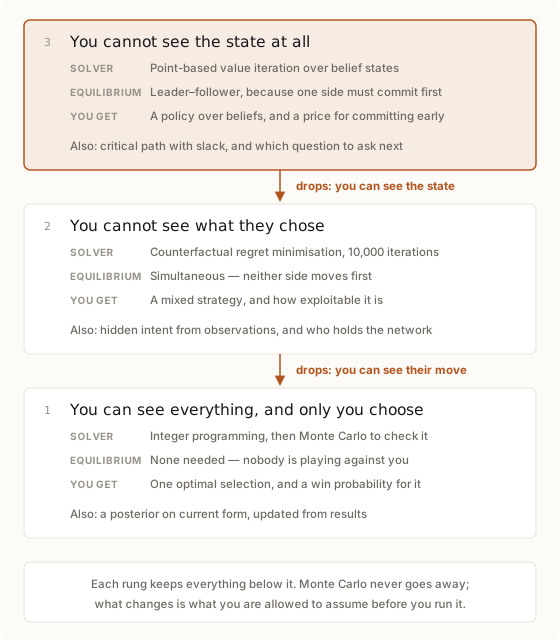
Each rung keeps everything beneath it. Monte Carlo appears in all three. What changes is what you may assume before you run it.
Rung one — you can see everything
The first system picks a cricket team. Full information: every player's record is public, the conditions are known, and nobody is hiding anything.
That makes it an optimisation problem rather than a game. Integer programming selects the eleven under the real constraints — role coverage, overs available, squad rules — and Monte Carlo estimates how often that eleven wins.
Three details worth carrying forward.
A second optimisation predicts the opponent's team. If they are also picking optimally, you can model that, and then pick against their likely eleven rather than against an average one.
The selection is made robust rather than optimal. Rather than trusting every form estimate equally, the model protects against a bounded number of the most uncertain opponent players simultaneously underperforming your expectation. You give up a little expected value for a solution that does not collapse when a couple of estimates are wrong. This is the single most transferable idea in the project — most real optimisation problems are fed by estimates, and the naive optimum is usually fitted to noise in those estimates.
Form is a posterior, not an average. A conjugate update over recent performances, with sampling used to explore rather than always picking the current best. And once enough real outcomes have been recorded, the probability outputs get recalibrated against them, because a simulator that says 70% should be right about seven times in ten.
The optimiser and the simulator also talk to each other: a bounded swap search feeds candidate elevens back through simulation, accepting a change only when it improves the win estimate by more than a set threshold, for at most a few rounds. That loop stops the optimiser from being confident about an objective the simulation disagrees with.
Rung two — you cannot see what they chose
The second system moves to a setting where the other side is choosing at the same time as you and you do not see their choice.
Optimisation no longer applies. There is no best move, only a best distribution over moves — and if you always pick your strongest option, you become predictable and therefore beatable.
The solver is counterfactual regret minimisation: play the game against itself many times, track how much you regret not having played each alternative, and adjust toward the ones you regret not playing. It converges to a strategy that is hard to exploit, and it reports how exploitable it still is, which is a genuinely useful thing to be able to state.
Two additions that made the output more honest than the maths alone:
Opponents are modelled as people, not as expected-value maximisers. Each adversary carries their own loss aversion and their own distortion of small probabilities, using the rank-dependent form of prospect theory rather than the simplified version. That matters because the whole point is predicting what someone will actually do, and people systematically overweight small chances and feel losses more than equivalent gains.
When there is only one opponent, the system skips the game theory entirely and solves it as a straightforward sequential decision problem. Regret minimisation is the right tool for a genuine multi-party standoff and unnecessary machinery for a two-party one.
The single best piece of code in the whole set lives here: a function that, given a decision that turned out badly, reports which behavioural distortion explains it. Not that the decision was wrong — which specific modelled bias produced it. That is the difference between a model that scores things and a model that explains itself.
Rung three — you cannot see the state
The third system removes the last assumption. You no longer observe the world directly; you get noisy signals and must act on a belief about what is true.
Planning now happens over belief states rather than states, and the exact solution is intractable as the state space grows — so it uses a point-based approximation: sample a set of representative beliefs, iterate value estimates over those, and accept a good policy instead of an optimal one.
And the equilibrium changes.
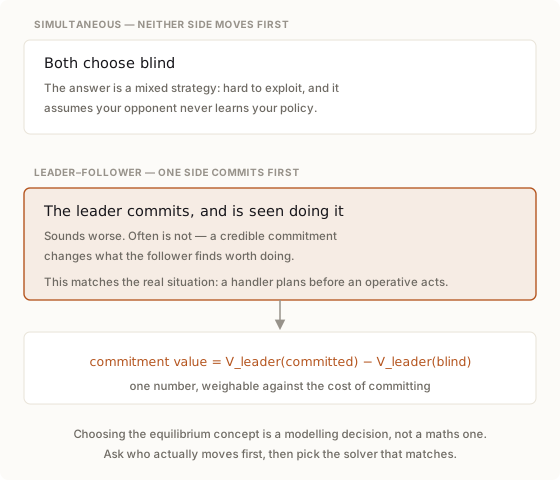
Rung two assumed both sides choose blind. That was wrong for this domain: a planner commits to an approach before the person carrying it out ever acts, and that commitment is visible. So the solver moves from a simultaneous equilibrium to a leader–follower one.
Committing first sounds like a disadvantage. Frequently it is not — a credible commitment changes what the other side finds worth doing. And because you can compute the leader's value under both, you can subtract them and get the price of committing early as a single number, which a planner can weigh against the flexibility they gave up.
That is the finding I would keep from all three projects. Choosing between equilibrium concepts is a modelling decision about who actually moves first, not a mathematical preference — and once you have both solvers, the difference between them is itself a useful output.
Two smaller mechanisms here are more broadly applicable than the game theory: classical critical-path scheduling with three-point estimates over the task graph, which surfaces where the slack is; and ranking candidate observations by how much uncertainty each would remove, so the planner knows which question to ask next. That second one — value of information — is underused almost everywhere.
The invariant
Across all three, the language model never decides anything. It writes the explanation after the solver has produced the answer.
Same input state, same recommendation, regardless of which model is loaded or what temperature it is set to. The prose changes; the decision does not.
I did not set out to make that a principle. It happened because the interesting part of each project was the formulation, and once the formulation exists, asking a language model to second-guess it is strictly worse than reporting it. I later found the same conclusion argued from production experience by teams at several conferences, and wrote about that in match decisions without a model in the loop.
Two honest caveats
One of these systems models covert operations, and I have framed that carefully here. It is built as a fictional planning exercise, but the technique — treating adversarial planning as an optimisation over beliefs — describes real activity with real consequences. I have kept the description at the level of method. It also refuses, structurally and at several independent entry points, to plan from the adversary's side, with no flag to turn that off. That refusal is part of the architecture rather than a policy note, which is the only version of such a constraint I trust.
The design documents oversell in one place. One project's write-up discusses causal inference and evolutionary dynamics at length. Neither is implemented — there is a schema and a rollout function, and no operator that would make the causal claim true. I am flagging it because I wrote those documents, and a design note describing an aspiration in the present tense is a small dishonesty that compounds.
The pattern, without cricket or spies
Pick the solver by asking what you cannot observe. Full observability and a single decision-maker is an optimisation problem. Hidden simultaneous choices is a game. A hidden state is a planning problem over beliefs. Getting this wrong means using elaborate machinery on a problem that did not need it, or a clean optimum for a situation that will not hold still.
| What you cannot see | The problem you actually have | Real examples |
|---|---|---|
| Nothing — full information | Constrained optimisation, robustified against estimate error | Rostering, network design, portfolio construction, scheduling |
| The other party's simultaneous move | A game; you need a distribution over actions | Pricing against a competitor, auction bidding, fraud versus fraudster |
| The state itself | Planning over beliefs, plus value of information | Medical diagnosis and testing, predictive maintenance, exploration, security monitoring |
| Who moves first is unclear | Compute both equilibria and price the difference | Regulatory commitment, published pricing, capacity announcements |
Three transfers:
Robustify rather than optimise when your inputs are estimates. Protecting against a bounded number of simultaneous bad estimates costs a little expected value and removes most of the fragility. Almost every optimisation fed by a forecast should do this and almost none do.
Ask who commits first before choosing an equilibrium. It is the question that determines the solver, and it is a fact about your domain that you probably already know.
Rank your next observation by uncertainty removed. If you can act to learn as well as act to achieve, the choice of what to learn deserves the same rigour as the choice of what to do.
References
| Source | Event | Recording |
|---|---|---|
| Intelligence in structure, not policy — structured methods benchmarked against learned ones | MLDS 2026, Mar 2026 | Not published |
| Deterministic coordination of a multi-agent system | Data Engineering Summit 2026, May 2026 | Not published |
| Constraints beat cleverness: the model for reasoning, not enforcement | MLDS 2026, Mar 2026 | Not published |
| Full hall recordings across three days | CYPHER 2025, Sept 2025 | Day 3, Hall 3 |
Source for the first and second systems is public: ipl-oracle and got-oracle.