Five dbt detectors sharing one output contract, and the timezone table that breaks all of them twice a year
Contact-centre rules about when you may call someone carry real penalties, and they change — so the structural question is whether adding next year's regulation means rewriting this year's checks. Five detectors that know nothing about each other, each emitting the same three fields, means a new rule is a new query rather than a schema migration. The interesting part is that the architecture is sound and the whole thing is still wrong for two months a year, because of a hardcoded timezone table nobody thought was interesting.
5 min read
Contents
Contact-centre compliance is a small, sharp problem. There are rules about when you may call someone, how often, and whether you may call them at all — and breaking them carries real penalties.
The modelling question is how to structure the checks so that next year's regulation does not require rewriting this year's.
One shape, five detectors
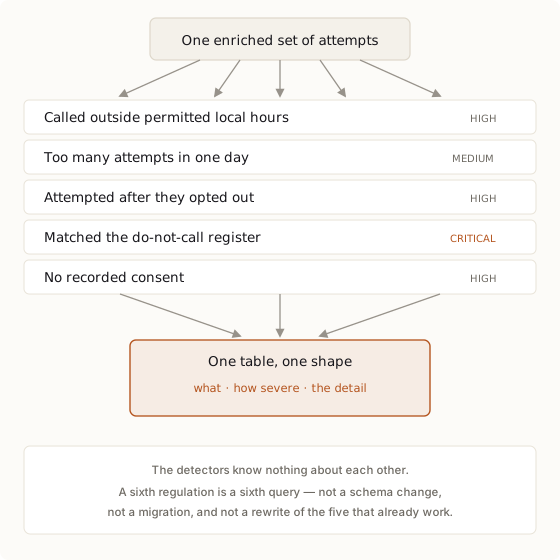
Five checks, each entirely independent, each emitting the same three fields: what was violated, how severe, and the supporting detail. They union into one table.
The detectors do not know about each other. Nothing coordinates them. Adding a sixth is adding a sixth query to the union — not a schema change, not a migration, and not a rewrite of the five that already work.
That is the whole idea, and it is worth stating because the tempting alternative is a single clever model with a column per rule. That version looks tidier and fails the moment a new rule needs a field the others do not have. A wide table with sparse columns is a schema that grows with the regulation count; a union of detectors is a schema that does not grow at all.
Severity belongs in the detector
Each detector declares its own severity, rather than severity being assigned downstream.
That is right because severity is a property of the rule, not of the finding. A do-not-call match is critical whether it happened once or a thousand times. Too many attempts in a day is a medium-severity pattern even in bulk. Deriving severity from volume — which is what a downstream ranking step would do — would systematically understate exactly the rare violations that matter most.
Matching on a hash
The do-not-call check joins on a hashed phone number rather than the number itself.
This is a small decision with a disproportionate payoff. The register can be distributed as hashes, the platform never needs to hold the raw numbers to do the matching, and the join works identically either way.
The general form: when you only need to test equality, you rarely need the value. Anywhere two systems must agree on whether they hold the same person without either learning the other's list, a hashed key does the job. It is worth asking of any join key that happens to be personal data.
The flaw I would fix first
The timezone conversion is a hardcoded table of fixed offsets, with no handling of daylight saving.
In a model whose entire purpose is deciding whether a call fell inside a legally permitted local window, that is not a rounding error. Twice a year, for a stretch of weeks, every calling-hours verdict for a large fraction of the population is off by an hour — in a direction that can turn a compliant call into a violation and, worse, a violation into a compliant-looking record.
Every part of the design above is sound. The correctness of the whole thing rests on an hour arithmetic that is wrong for two months of the year.
I am including it because it is the most realistic thing in this post. The
architecture was the interesting problem and got the attention; the timezone
handling was boring and got a CASE statement. That is how compliance systems
usually fail — not in the structure, in the part nobody wanted to think about.
The pattern, without the contact centre
Model rule-checking as a union of independent detectors sharing one output contract. Let each own its severity. Never let one detector's schema needs reach another. And be suspicious of the boring conversion sitting underneath the interesting logic, because that is where the actual bug will be.
| Setting | The detectors | The boring thing that breaks it |
|---|---|---|
| Financial crime | Threshold breaches, structuring patterns, sanctions matches, PEP exposure | Currency conversion dates |
| Data protection | Retention overruns, missing lawful basis, cross-border transfers, unfulfilled deletions | What counts as the retention start |
| Employment | Working-time breaches, rest-period gaps, unpaid overtime, missing right-to-work | Timezone and shift-boundary handling |
| Clinical safety | Contraindications, dose ceilings, missing monitoring, expired consent | Age at the time of the event, not today |
| Environmental | Emission thresholds, permit expiries, monitoring gaps | Unit conversion between reporting standards |
Every one of those right-hand entries is a units-and-time problem, which is not a coincidence. Rules are interesting and get reviewed. Conversions are dull and get written once.
Three transfers:
One output contract, enforced. Every detector returns the same fields. That single constraint is what makes the union work and what keeps the marginal cost of a new rule near zero.
Severity at the source. The rule knows how bad it is. Nothing downstream has the context to work that out from frequency.
Hash the join key when you only need equality. It removes an entire class of data-handling obligation for no functional cost.
References
| Source | Event | Recording |
|---|---|---|
| Compliance-aware data platforms and governed access | Data Engineering Summit 2026, May 2026 | Not published |
| Telemetry and enforcement for audit completeness | Data Engineering Summit 2026, May 2026 | Not published |
| Data contracts and shared metric definitions | Data Engineering Summit 2024, May 2024 | Not published |
| Full hall recordings across three days | CYPHER 2025, Sept 2025 | Day 2, Hall 2 |
Source is public: cci-platform. The data in it is synthetic.