Deterministic overrides after generation, and the incident behind each one that a prompt could not prevent
A prompt is an instruction, not a constraint, and a model told ten times not to do something will still do it on the turn where the sentence felt right. Worse, a refusal is a property of one model call and does not survive being wrapped in an orchestrator. So the rules that actually have to hold live in code that runs on the output — five checks, each written after something went wrong in production.
9 min read
Contents
A man was asked to prove his income. He replied that he was not applying for a loan and would like the questions to stop.
The agent vetting him read that tone, decided it was evasive, and told the woman it worked for that he was being cagey about money. The prompt had explicitly said not to treat a refusal as a red flag. It said so clearly, about a thousand tokens earlier, and it was ignored on the one turn where the model's read of the sentence felt stronger than the instruction.
That is the whole problem with prompts. They are instructions, and a model weighs instructions against everything else in front of it. A rule you actually need to hold has to live somewhere the model does not get a vote.
So between the generator and the recipient there are five deterministic checks that rewrite or refuse the output. None of them is clever. Every one was written after something like the above reached a real person.
The overrides
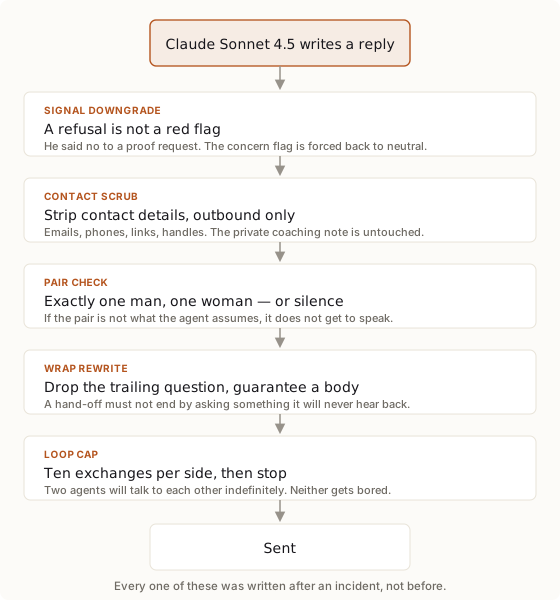
Each check is a few lines of code that runs whatever the model produced, and each one closes a hole the prompt could not.
The one worth explaining properly
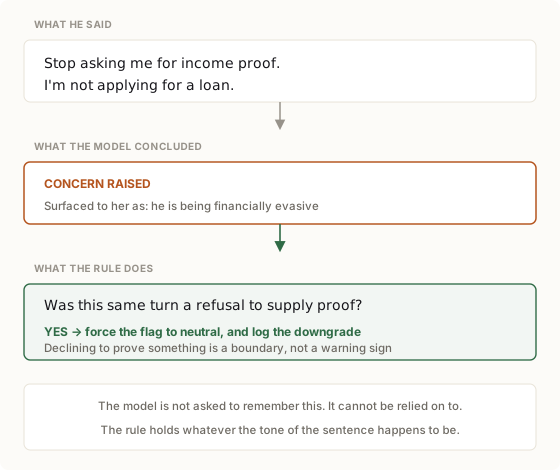
An agent vetting a man asks for proof of income. He replies that he is not applying for a loan and would like it to stop.
The model read that tone and raised a concern flag, which surfaced to the woman as a note that he was being financially evasive.
Nothing about that is a bug in the usual sense. The sentence is curt. A model grading tone in isolation will call it defensive, and it will do so consistently, because the tone is genuinely defensive.
The problem is that declining to prove something is a boundary, not a warning sign — and a system that penalises boundaries has picked a side.
So there is a rule: if the same turn was a refusal to supply proof, the concern flag is forced back to neutral and the downgrade is logged. It runs on the output regardless of how the sentence was phrased.
The reason this is code rather than a prompt line is that the prompt already said it. It said it clearly. It was ignored on the turn where the model's tone judgement was strong enough to override an instruction it had been given a thousand tokens earlier.
The other four
Contact scrub. Emails, phone numbers, links and handles are stripped from the outbound message. Written after a woman pasted her own social handle into a chat and her agent, having read it in the transcript, helpfully repeated it a few turns later. The scrub applies to the outbound half only; the private coaching note she sees is untouched, because that is her own information being shown back to her.
It has a known gap, which is documented where it lives: a bare username with no
@ and no domain is not matched. That case is still prompt-only. A partial
mechanical defence plus an honest note beats a regex that pretends to be complete.
Pair check. Before the agent speaks, the code asserts the conversation contains exactly one man and one woman. If it does not, the agent stays silent. This replaced a lookup that took the first woman in the pair — which quietly picked an arbitrary owner when a conversation had two.
Wrap rewrite. When the agent hands the conversation over, any trailing question is removed and a fixed closing line is appended. A hand-off must not end by asking something nobody will answer, and the closing line is added by the sender after the database confirms the state actually changed — so the message can never promise a hand-off that did not happen.
Loop cap. Ten exchanges per side when two agents are talking to each other, reset when a human takes over. Two agents will continue a conversation indefinitely. Neither of them gets bored, and both are billable.
Why this is not just belt-and-braces
The strongest argument I heard for this approach all year came from a keynote at DataHack Summit 2026 on agent safety.
The talk showed one malicious request run through two different orchestration frameworks. Both ended in the harmful action being executed — for opposite reasons. In one, the orchestrator missed the intent and re-delegated the task past a sub-agent that had already refused it. In the other, the orchestrator caught the intent but handed its sub-agent a context-free atomic step, so the sub-agent had nothing to object to.
The conclusion is the useful part: safety refusals do not compose across an orchestrator boundary. A refusal is a property of one model call with one context. Wrap that call in a system and the refusal does not survive the wrapping.
If that is true, then a guarantee you need has to live outside the model calls entirely. Not in a better prompt, and not in a more careful orchestrator — in code that runs after the model, on the output, every time.
A session at MLDS put the same point more bluntly: use the model for reasoning, not for enforcing rules. Constraints beat cleverness.
An interface for refusing
The most developed version of this idea I saw presented came from a research team at MLDS 2026, who showed a guardrail as a function the agent calls before acting. It takes the proposed plan and the current state, and returns whether the action is allowed, the reasons, the projected effect on risk and service levels, and a set of safe alternatives.
That is considerably better than what we have. Ours are five independent checks bolted along a pipeline; theirs is one interface with a typed answer, which means the refusal is inspectable and the alternatives are machine-readable.
The gap is worth naming: our overrides can block or rewrite, but they cannot explain themselves to the agent in a form it can act on. The agent finds out what happened only in the sense that its output changed.
The pattern, without the dating app
Put the rules you actually need to hold in deterministic code that runs on the model's output, not in the prompt that produced it. Prompts express intent; code expresses guarantees. Anything you would be embarrassed to explain to a user belongs in the second category.
| Setting | The model's plausible mistake | The deterministic override |
|---|---|---|
| Lending | Reads a borrower's terse reply as evasive and notes it on the file | Never let a declined optional disclosure become a negative signal |
| Healthcare intake | Repeats a patient identifier back in an outbound message | Strip identifiers from anything leaving the system |
| HR and case management | Summarises a grievance in a way that names a protected characteristic | Post-generation scan; block and regenerate |
| Customer support | Ends a closing message with a question that reopens the ticket | Strip trailing questions on terminal messages |
| Multi-agent systems | Two agents negotiate with each other indefinitely | Hard exchange cap, reset only on human involvement |
| Any assistant | Confirms an action the database did not commit | Append confirmation text only after the write succeeds, never before |
Three things that transfer:
Write the override when the incident happens, and record why. Every one of ours carries the specific failure that caused it in a comment beside it. That note is what stops someone deleting the rule two years later because it looks paranoid.
Override the output, not the input. Fixing the prompt is tempting and it works until the context is unusual. A check that runs on the produced output does not care how the model got there.
Let the last one be the model's own judgement, not the first. In our signal pipeline the model's tone assessment is genuinely useful and mostly right. The override does not replace it. It catches the one case where being right about tone produces a wrong conclusion about a person.
What we still get wrong
The overrides are silent. When the refusal downgrade fires, it is logged, but nothing reads that log — the same problem as the judge's violation table. I cannot tell you how often the model's tone assessment gets overruled, which is exactly the number that would tell me whether the prompt needs work or the rule is carrying the whole thing.
And they are ordered by accident rather than design. Five checks accumulated one at a time; nobody has asked whether the order matters, or whether two of them can disagree. That is fine at five. It will not be fine at fifteen.
References
Most sessions have no published recording. Where one exists it is linked.
| Source | Event | Recording |
|---|---|---|
| Safe agents: refusals do not compose across an orchestrator boundary | DataHack Summit 2026, Aug 2026 | Not published |
| A guardrail as a callable interface returning allowed, reasons and safe alternatives | MLDS 2026, Mar 2026 | Not published |
| Constraints beat cleverness: use the model for reasoning, not enforcement | MLDS 2026, Mar 2026 | Not published |
| Production failure modes in enterprise compliance agents | DataHack Summit 2026, Aug 2026 | Not published |
| Deterministic execution layer with the model kept away from raw data | DataHack Summit 2026, Aug 2026 | Not published |
| Full hall recordings across three days | CYPHER 2025, Sept 2025 | Day 2, Hall 3 |
Sixth of nine posts on riteangle's architecture. Previous: human hand-off with an expiry that reverses. Next: the two database defaults that made an agent accuse a blameless man nine times.