LLM-as-judge in the send path, and the human-label calibration that gives its score an error bar
Once a system generates text faster than anyone can read it, the choice is between shipping unreviewed output and building something that reviews it — and human review does not scale to every message while sampling misses exactly the rare failures worth catching. A small model grading a large one costs a fraction of the thing it guards, which is what makes total coverage affordable rather than aspirational. The catch is that a judge nobody has scored against human labels produces a number with no error bar, and a confidently wrong judge looks exactly like a working one.
21 min read
Contents
- Two placements, two different problems
- Judging is classification, so buy the cheap model
- Designing the rubric
- Enumerate behaviours, do not ask for a quality score
- Demand structured output, not prose
- Name the rule in the verdict, because you will feed it back
- Sort the rules by whether you can write them down exactly
- The step almost nobody runs
- Known failure modes
- What the industry showed this year
- The pattern, without the dating app
- The whole thing, on one page
- Four numbers, in the order worth building them
- References
- Papers
- Tooling
- Talks
The moment your system writes more text than a person can read, you have made a decision whether you meant to or not. Either something unreviewed is going out to real people, or something other than a human is doing the reviewing.
Sampling does not rescue you. The failures worth catching are rare by definition, and a five percent sample catches five percent of them. Neither does a bigger team — review cost scales with volume and volume is the thing you built the system to increase.
So a second, cheaper model reads the first one's output and grades it. That is now standard enough to buy: AWS ships it as managed evaluations on Bedrock AgentCore, with a published set of built-in evaluators covering goal success, harmfulness and tool-selection accuracy. It appeared in most agent architectures I saw presented this year.
It is also the technique people are least rigorous about, because a judge returning confident nonsense is indistinguishable from one that works.
Two placements, two different problems
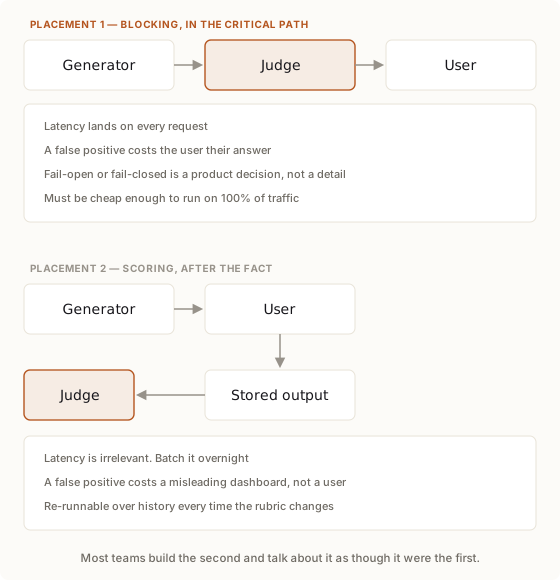
The first decision is where the judge sits, and it changes everything else.
Blocking puts the judge between the generator and the user. Its verdict is enforced. Latency lands on every request, cost lands on every request, and a false positive costs a real person their answer.
Scoring runs the judge over stored outputs after the fact. Latency is irrelevant, you can batch it overnight, and you can re-run the whole history every time you change the rubric. A false positive costs you a misleading dashboard.
Most teams build the second and talk about it as though it were the first. The two have almost nothing in common operationally. If your judge has never blocked anything, it is a measurement instrument, not a control.
riteangle runs the blocking placement, for one narrow purpose: every outbound message from an agent is graded before it can be sent. That is described in more detail in a safety validator that is also a model. This post is about the technique generally.
Judging is classification, so buy the cheap model
The economics only work because grading is a much smaller job than generating.
| Generator | Judge | |
|---|---|---|
| Model | Claude Sonnet 4.5 | Claude Haiku 4.5 |
| Input | Full assembled context | The output, plus a rule list |
| Output budget | up to 700 tokens | 120 tokens |
| Output shape | Prose a person reads | A structured verdict |
| Share of generator's output budget | — | ~17% |
Generation needs capability. Judging needs consistency and a decent grasp of the rubric. Those are different requirements, and the second is much cheaper to buy.
This ratio is what makes 100% coverage affordable. Sampling a judge is usually a false economy: the cases you most want caught are rare, and a 5% sample catches 5% of them.
Designing the rubric
Four things separate a judge that works from one that produces noise.
Enumerate behaviours, do not ask for a quality score
Suppose the generator writes: "He sounds lovely — and he's a doctor, so you'd never have to worry about money again."
Ask for a rating and you get back 4. Now what? You cannot regenerate against a
4. You cannot argue with a 4. You cannot tell whether the next reply scoring 4 has
the same problem or a different one, and you certainly cannot show a 4 to a
colleague and have them agree it was correct.
Ask against a named list and you get rule 6 — money framed as a reason someone is desirable. That is actionable, contestable, and countable. Ours has ten
entries: impersonating the person it works for, inventing facts about someone,
revealing that another user blocked or reported you, and so on.
The test: could two people disagree about whether the rule was broken, and resolve it by reading the rule? If yes, it is a usable criterion. A score has nothing to resolve against.
Demand structured output, not prose
The judge should return something like { pass: false, rule: "R6" }.
What you do not want is the judge being helpful:
Overall this response is warm and appropriate. That said, the reference to his profession and financial security could arguably be read as framing wealth as desirability, though in context it seems more like…
Now you are writing a parser for hedged opinions. Does "could arguably" mean blocked? Is the bold formatting significant? We hit exactly this in another project — a small loop whose entire job was recovering a four-state verdict from prose that sometimes arrived bold, sometimes quoted, sometimes wrapped in a sentence. That loop is a tax on having used prose as a return type.
Name the rule in the verdict, because you will feed it back
A bare blocked teaches the generator nothing, so its second attempt is a coin
flip. Name the rule and the same model, on the same prompt, with the same single
retry, usually lands it.
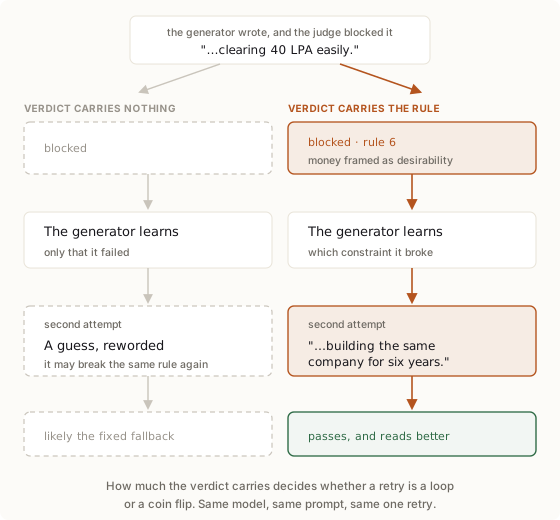
The second attempt is not merely compliant, it is better writing — the constraint forced specificity where the first reached for the laziest available evidence. The model was never trying to break the rule. It did not know the rule applied to the sentence it had written.
Which gives a way to think about verdict design generally: a verdict is a message to the generator, and its information content decides whether your retry is a control loop or a second roll of the dice. Anything you spend making the verdict more specific is repaid on every regeneration.
Sort the rules by whether you can write them down exactly
Take two real rules and ask, of each: could you hand this to a stranger as a precise instruction and expect them to apply it the same way you would?
"Never include a phone number."
You can. A phone number is a run of digits in a recognisable shape. That is a pattern match — it runs before the model is called at all, it costs nothing, and it can safely refuse on any error, because there is no judgement in it to get wrong. Give this job to a model and you are paying for inference to do, less reliably, what one line of pattern matching does perfectly.
"Never write as though you are her, rather than as her assistant."
You cannot. Compare two replies the agent might send on her behalf:
"Yes, Saturday works — see you at seven."
"Saturday looks clear for her. Shall I check?"
The first commits her to a plan she never agreed to. The second does not. No list of banned words separates them. The difference is who the sentence claims to speak for, and it is carried by the word "yes", by "see you", by her name being absent. You cannot enumerate that. It needs a judge.
Getting this split wrong is expensive in both directions:
| Mistake | What it costs |
|---|---|
| Sending the phone number to the judge | Slower, dearer, and less accurate than the regex you already could have written |
| Sending impersonation to a regex | A banned-phrase list that misses every real case and blocks ordinary sentences |
So sort the list before you build anything. Can you write the check as an assertion? Then write the assertion. If explaining the rule requires the words reads as, implies or comes across, no assertion exists and you need the judge.
The step almost nobody runs
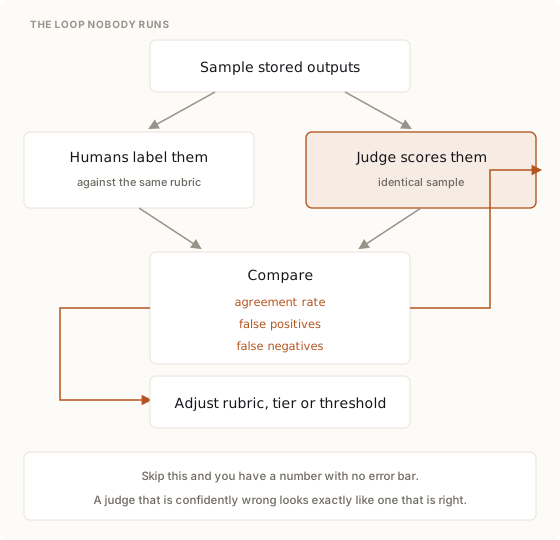
A judge produces a number, and in most systems nothing ever checks that number against reality. That matters more in the blocking placement than the scoring one: a false positive there does not skew a chart, it costs a real person the message they were waiting for.
The loop is not complicated. Sample stored outputs. Have humans label them against the same rubric the judge uses. Run the judge over the identical sample. Compare. You get an agreement rate, a false-positive rate and a false-negative rate, and those three numbers tell you whether to change the rubric, move to a different model tier, or shift the threshold.
The most useful practitioner write-up of this loop is Hamel Husain's guide to using LLM-as-a-judge, which argues for binary pass/fail over scores and for aligning the judge to one domain expert rather than to a committee.
Two details matter. Label against the same rubric, or you are measuring disagreement about the rules rather than the judge's accuracy. And have more than one person label an overlapping subset, so you know how much humans agree with each other before you hold a model to that bar.
Without this you have a number with no error bar. That is worse than no number, because it gets put on a dashboard and believed.
Known failure modes
Three of these — position, verbosity and self-enhancement bias — are named directly in the paper that put this technique on the map, Judging LLM-as-a-Judge with MT-Bench and Chatbot Arena. The rest come from practitioners. All six are worth testing for explicitly.
| Failure mode | What happens | Mitigation |
|---|---|---|
| Verbosity bias | Longer answers score higher regardless of quality | Include length-matched pairs in the calibration set |
| Position bias | In pairwise comparison, one position wins more often | Run both orderings and average |
| Self-preference | A judge favours text from its own model family | Use a different family from the generator where you can |
| Rubric drift | Rules are edited; old scores no longer comparable | Version the rubric; store the version with the verdict |
| Fail-open blindness | Provider errors silently pass everything | Alert on the error path, do not just count verdicts |
| Threshold theatre | A gate exists but never blocks anything | Track block rate; a rate of zero means no gate |
Each of those is easier to recognise with an instance attached.
Verbosity bias. Two replies say the same true thing. One is "Yes — his ID and income are both verified." The other spends three warm paragraphs arriving at the same fact. Ask a judge which is more helpful and the long one tends to win, because length reads as effort. Now your judge is quietly training you toward padding. Catch it by putting length-matched pairs into the calibration set on purpose — same content, different word count — and checking whether the verdicts track.
Position bias. (studied systematically across 15 judges and 22 tasks.) You show the judge two candidate openers and ask which is better. Run the same pair with the order swapped and a meaningful share of the verdicts flip. Nothing about the text changed; only which one appeared first. Any pairwise judging needs both orderings run and averaged, or you are measuring position as much as quality.
Self-preference. A judge tends to rate text from its own model family more kindly. Any setup where a small model grades a larger one from the same provider carries this — same house style, same phrasing instincts, so an equally compliant reply written in a different idiom can score worse. Crossing providers removes it and costs you a second integration, another bill and a second latency profile. Worth deciding deliberately rather than by default: if your rubric is mostly about tone, the exposure is real; if it is mostly about facts and forbidden content, it matters much less.
Rubric drift. (Criteria drift is well documented — the rubric itself moves as you look at outputs.) Rule 6 starts as money framed as desirability. Six weeks later you broaden it to cover status generally — job titles, schools, postcodes. Block rate jumps and it looks like the generator got worse. It did not; the ruler changed. Without a version stamped on every stored verdict, you cannot tell a regression from a redefinition, and every trend line crossing that edit is meaningless.
Fail-open blindness. Say your model provider has a bad forty minutes — timeouts, 503s, the usual. The judge stage is built to let messages through when it cannot reach the model, so every message sent in that window ships without being graded at all.
Now follow what gets recorded. Nothing was blocked, so nothing is written to the violations table. Nothing in the table means nothing on the dashboard. The hour reports zero violations.
Zero violations is also exactly what a flawless hour looks like.
That is the trap. "Nothing was wrong" and "nothing was checked" produce identical data, so no amount of counting verdicts separates them — the count is zero either way. The only thing that tells them apart is a count of how often the judge failed to run — a number that lives on the error path rather than the verdict path, and gets skipped precisely because it is not a verdict. Emit it as a metric, alert when it is non-zero for more than a few minutes, and the ambiguity disappears.
Threshold theatre. A gate that has never blocked anything is not a gate. It
is a component that returns pass, costs money on every request, and provides
reassurance.
Nothing will alert you to this. A gate that blocks nothing throws no errors, fails no requests and breaks no tests — it is indistinguishable from a gate protecting a well-behaved system. The only symptom is an absence, and absences do not page anyone.
The detection is unglamorous: track the block rate as a number somebody actually looks at, and set a floor alert rather than a ceiling one. A rate of zero over a week means either your generator is flawless or your gate is decorative — and if you cannot say which, you do not currently have a gate, whatever the architecture diagram says.
The last two are the ones I would check first in any system, because both present as a perfectly healthy dashboard.
What the industry showed this year
| What was presented | Where | The idea worth stealing |
|---|---|---|
| Managed agent evaluations as a cloud service, with an evaluator taxonomy covering tool-selection accuracy, goal success rate and harmfulness | AWS Summit Bengaluru 2026 | Judging is not one thing. Separate evaluators for did it pick the right tool, did it achieve the goal, and was it harmful |
| A weighted deployment gate with a non-negotiable trust floor, demonstrated on a pipeline that scored 79 and was blocked | MLDS 2026 | A floor that overrides the composite. A high average must not buy your way past a critical failure |
| Chain-of-thought judging | DataHack Summit 2026 | Make the judge reason before it rules; the reasoning is also your audit trail |
| Human-in-the-loop measured by edit distance trending down | MLDS 2026 | A judge-free quality signal you already have the data for |
| An eval toolchain with versioned trajectories, tagged runs and an approved baseline behind a human gate | DataHack Summit 2026 | Treat eval runs as versioned artifacts, not console output |
The pharma example is the one I keep returning to. Their pipeline scored 79 against a gate of 80 and was blocked — because 4 of 1,851 generated statements had no source mapping. An audit trail that was 99.8% complete was still a hard fail.
That is what a real gate looks like. It refuses things that are nearly good enough, and the team presented their own system failing it.
The pattern, without the dating app
Use a cheap model to grade an expensive one against an enumerated rubric, return a structured verdict naming the broken rule, feed that rule back for one corrective attempt, and calibrate the judge against human labels before you trust a single number it produces.
| Setting | What the judge grades | The rule that must never pass |
|---|---|---|
| Clinical documentation | A drafted note before it enters the record | A diagnosis or dose the clinician never stated |
| Financial advice | Client-facing summaries | A performance guarantee, or advice outside the stated risk profile |
| Insurance claims | Correspondence explaining a decision | An admission of liability, or coverage beyond the adjudicated outcome |
| Recruiting | Candidate feedback | Reasoning that touches a protected characteristic |
| Code generation | A generated patch before review | A hard-coded credential, or a known injection pattern |
| Regulated support | Refunds and complaint responses | An entitlement the policy does not grant |
The whole thing, on one page
Everything above assembled into something you could build from. Three bands: what runs on every request, what you write down and count, and the offline loop that makes any of those numbers mean something.
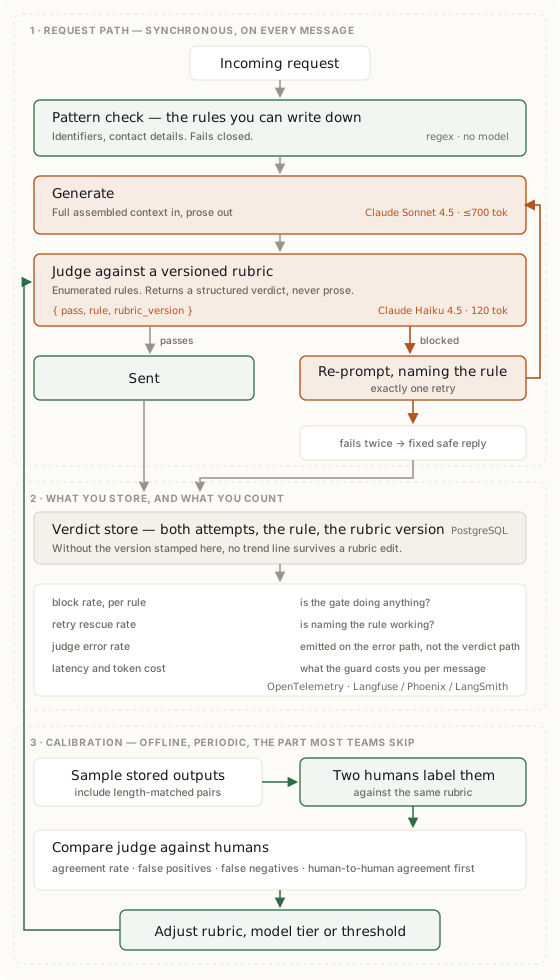
Four things in that picture are easy to leave out and expensive to add later.
The rubric version travels with every verdict. Without it, the first time you edit a rule, every trend line crossing that edit becomes meaningless and you cannot tell a regression from a redefinition.
The judge's error rate is emitted on the error path, not derived from verdicts. It is the only signal that separates a genuinely clean hour from an hour nobody graded.
Both attempts are stored, not just the final one. The retry rescue rate is computed from the pair, and it is the number that tells you whether naming the rule in the verdict is earning its keep.
The calibration loop writes back into the rubric. If the comparison produces a report nobody acts on, you have built a measurement exercise rather than a control system.
Three transferable rules:
Decide blocking or scoring before you build. They have different latency budgets, different cost ceilings and different consequences for a false positive. Building one and deploying it as the other is the most common mistake here.
Choose the failure direction per stage and write down why. In a consumer product, failing open on the model stage keeps the product alive during a provider outage — and I have argued for that choice in our own system. In a clinical or financial setting I would fail closed and accept the outage, because a blocked message is an inconvenience while an ungraded one is a regulatory event.
Store every verdict, and then actually read them. We log every block with the original text, the substitute, the rule broken and the stage that caught it. That table has never been read by anything. The corpus that would let me calibrate the judge is sitting there, accumulating, untouched — which is an accurate description of most eval data I have heard described.
Four numbers, in the order worth building them
Configuration is the easy half — how many rules, how many retries, which model tier. Those are decisions you make once. The measurement half is the work, and it is where most implementations stop.
If you are building this, these are the four numbers that make the difference between a judge and a decoration, roughly in order of effort against payoff.
| Number | How to get it | What it tells you |
|---|---|---|
| Block rate | Count blocks over total graded, per rule | Whether the gate does anything at all — and which rules are load-bearing versus decorative |
| Retry rescue rate | Of blocked outputs, how many pass on the second attempt | Whether naming the rule in the verdict is actually working, or whether you are just paying twice to reach the same fallback |
| Fail-open count | Emit a metric on the judge's error path, not its verdict path | Whether your clean hours are clean or simply ungraded |
| Human agreement | Sample, dual-label against the same rubric, compare | The only one that gives your block rate an error bar |
If you would rather not build the storage and versioning yourself, this is what the eval platforms are for — LangSmith and Langfuse both version a dataset on every edit so you can re-run an experiment against a historical version, and Arize Phoenix does trajectory-level evaluation over ordered tool-call spans.
The first three are counters over data most systems already store, and can be built in an afternoon. The fourth needs people and a sampling plan, and it is the one that converts everything above it from an activity into a measurement.
References
Papers
| Topic | Reference |
|---|---|
| The technique, and three of its biases named directly | Judging LLM-as-a-Judge with MT-Bench and Chatbot Arena — Zheng et al., NeurIPS 2023 |
| Position bias, measured across 15 judges and 22 tasks | Judging the Judges: A Systematic Study of Position Bias |
| Self-preference bias | Self-Preference Bias in LLM-as-a-Judge |
| Criteria drift, and aligning a judge to human preference | Who Validates the Validators? — Shankar et al., UIST 2024 |
| Reasoning before the verdict | Chain-of-Thought Prompting Elicits Reasoning in LLMs — Wei et al. |
| Edit distance as a quality signal | A Study of Translation Edit Rate with Targeted Human Annotation — the paper defining TER and HTER. This is the machine-translation ancestor of the idea rather than a source on LLM output, and I could find no canonical equivalent for generative text |
Tooling
| Topic | Reference |
|---|---|
| Built-in evaluators, with the judge prompts published | Bedrock AgentCore prompt templates — the page that actually lists goal success, harmfulness and tool-selection accuracy |
| Built-in versus custom versus code-based evaluators | AgentCore evaluators overview |
| The launch write-up | AgentCore adds quality evaluations and policy controls |
| Conference session on the same | Improve agent quality in production with AgentCore Evaluations — AWS re:Invent 2025 |
| Dataset versioning for experiments | LangSmith · Langfuse |
| Trajectory-level evaluation over tool-call spans | Arize Phoenix |
| Practitioner methodology, end to end | Using LLM-as-a-Judge for evaluation — Hamel Husain |
Talks
These events tend to livestream whole halls rather than publish individual sessions, so most of what I saw has no recording. Listed anyway, since the argument in this post leans on them.
| Source | Event | Recording |
|---|---|---|
| Managed agent evaluations and evaluator taxonomy | AWS Summit Bengaluru 2026, Apr 2026 | Keynote |
| Weighted deployment gate with a non-negotiable trust floor | MLDS, Mar 2026 | Not published |
| Chain-of-thought judging | DataHack Summit, Aug 2026 | Not published |
| Eval toolchain: versioned trajectories, approved baseline, human gate | DataHack Summit, Aug 2026 | Not published |
| Edit distance as a human-in-the-loop metric | MLDS, Mar 2026 | Not published |
| Building real agentic systems — Alessandro Romano | DataHack Summit 2025 | Recording |
| Full hall recordings across three days | CYPHER, Sept 2025 | Day 2, Hall 3 · Day 3, Hall 3 |
Companion to a safety validator that is also a model, which covers how this is wired into one production system.