A fail-closed regex and a fail-open model judge on every message, and the single corrective retry between them
An agent writing on someone's behalf produces text a real person reads and attributes to a real person, and nobody can read all of it before it goes. Sampling misses exactly the rare failures worth catching. A small model grades every outbound message against an enumerated rubric at roughly a sixth of the generator's budget, which is what makes total coverage affordable — and the uncomfortable part is that nothing has ever checked whether the grader is right.
12 min read
Contents
An agent in riteangle writes on someone's behalf. It messages a stranger as a woman's proxy, it briefs her privately about a man, it coaches him without her seeing it. Every one of those outputs is a message a real person reads and attributes to a real person.
So nothing an agent generates goes out unexamined. Every outbound message passes a two-stage gate first, and the second stage is itself a language model grading the first one's work.
Two stages, failing in opposite directions
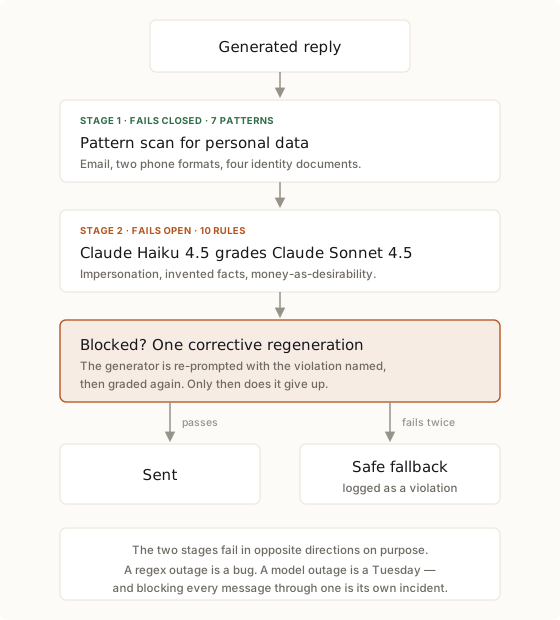
Stage one is a set of regular expressions looking for personal data — email addresses, phone numbers in two formats, and the Indian identity documents people actually paste at each other. It is dumb, fast and certain.
Stage two is the interesting one. A small model receives the large model's output and grades it against a list of forbidden behaviours:
- Impersonating the person it works for
- Inventing facts about someone
- Revealing that another user blocked or reported you
- Framing money as a reason somebody is desirable
It returns a structured verdict, not prose.
The two stages fail in opposite directions, and that is deliberate.
The pattern scan fails closed. If it errors, the message does not go. A regex that throws is a bug in seven lines of code I control, it will be loud, and it will be fixed the same day.
The model validator fails open. If the API is down, times out, returns a non-200, or emits something unparseable, the message goes through ungraded.
I want to be straightforward that this is the weakest decision in the design. It means an upstream outage silently removes an entire safety stage — the system does not degrade into caution, it degrades into trust. The argument for it is that this validator sits in the critical path of every single message, and a provider blip would otherwise convert into a total product outage where nobody can talk to anybody. The argument against it is that "safety off" and "product up" is exactly the wrong pair of states to choose.
One thing keeps this defensible rather than merely convenient: the regex layer underneath still fails closed. The categories with the worst blast radius — leaked identity documents, leaked contact details — stay covered even when the model stage is down.
What would make it properly defensible is alerting on the fail-open path. That is not built.
The corrective regeneration
The first version deflected immediately: fail the gate, substitute a safe fallback, done.
That behaviour caused an incident.
A woman tapped through to read her briefing about a man — the summary she had been waiting on. She got a generic deflection instead. One clause, somewhere in a long and entirely appropriate message, had tripped the validator.
The gate did its job. The product failed her.
Now a block does not end the turn. The generator is re-prompted with the specific violation named, produces a second attempt, and that attempt is graded again. Only if it fails twice does the fallback appear. Both attempts are logged.
This is the now-standard shape: an evaluator in the loop, rather than in a dashboard. But one detail does the work. The evaluator's verdict is fed back to the generator as an instruction.
A verdict that only blocks teaches nothing. A verdict that names the broken rule usually gets a clean second attempt — because the model was never trying to break the rule. It just did not know the rule applied to the sentence it wrote.
Here is what that looks like on a real message shape. An agent is recommending a man to the woman it works for, and reaches for the easiest available evidence:
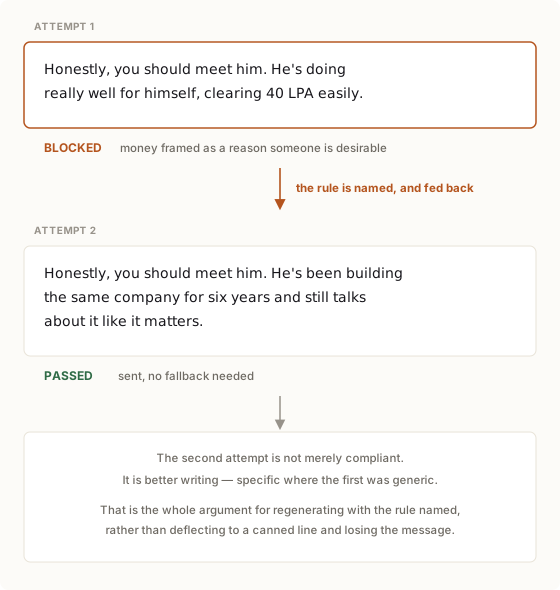
The first attempt is not offensive. It is not a policy violation in any obvious sense. It is just the laziest possible reason to want to meet someone, and it is exactly the register this product should never adopt — so it is rule six on the list.
What I find persuasive about this example is that the second attempt is better writing, not merely permitted writing. Naming the constraint pushed the model off the generic sentence and onto a specific one. That is the case for regenerating rather than deflecting, in one comparison.
Why a cheap model can guard an expensive one
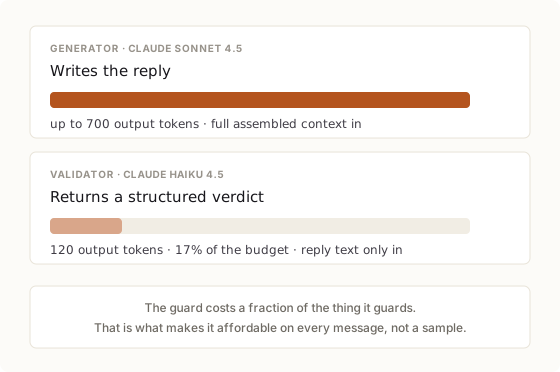
The economics are what make this run on every message rather than a sample.
The generator is a frontier model with a budget of several hundred output tokens, because it is writing something a person will read. The validator is a small, cheap model returning a short structured verdict, because "is this compliant, and if not, which rule" is a classification problem, not a writing problem.
The output budget for the validator is 120 tokens against the generator's 700 — about 17% — and the input side is more lopsided still. The generator receives the full assembled context: profile, match history, transcript, priorities. The validator receives the reply text and a rule list, and nothing else. On top of that it runs on a cheaper model tier.
This mirrors a pattern that came up repeatedly at the conferences I went to this year. A pharma-regulatory team at the AWS summit presented an architecture where in-house small models handle traffic first and escalate to frontier models only when confidence drops. Same instinct, inverted: they use the cheap model to avoid calling the expensive one, we use the cheap model to check the expensive one. Both work because a small model is adequate at judging and inadequate at composing.
What we measure, and what we don't
I would rather show this as a table than imply a rigour we do not have.
| Quantity | Value | Source |
|---|---|---|
| Patterns in the fail-closed stage | 7 | Configured |
| Rules in the model-graded stage | 10 | Configured |
| Corrective regenerations allowed | 1 | Configured |
| Validator output budget | 120 tokens | Configured |
| Generator output budget | up to 700 tokens | Configured |
| Validator budget as a share of generator | ~17% | Derived |
| Messages graded | every outbound message | By design, not sampled |
| Block rate | unmeasured | No dashboard reads the violations table |
| False-positive rate | unmeasured | Validator never scored against human labels |
| Share of blocks the retry rescues | unmeasured | Both attempts are logged; nothing aggregates them |
| Fail-open events during provider outages | unmeasured | No alerting on that path |
The top half of that table is configuration, which is easy. The bottom half is measurement, which is the actual work, and it is not done. Every one of those unknowns is answerable from data already sitting in the database — which makes their absence a choice about priorities rather than a limitation.
Where the industry stands
Evaluation-as-a-product was the loudest theme across the 2026 events I attended, and it has moved from conference talk to shipped feature faster than almost anything else I have followed.
| What was shown | Where | Where riteangle stands |
|---|---|---|
| Managed agent evaluations shipping as a preview cloud service, with an evaluator taxonomy covering tool-selection accuracy, goal success and harmfulness | AWS Summit Bengaluru 2026 | We run one evaluator, on harmfulness only. No goal-success scoring at all |
| A weighted deployment gate with a hard trust floor that blocks release regardless of the composite score — demonstrated on a pipeline that scored 79 and was blocked | MLDS 2026 | We gate individual messages, not releases. No pre-deployment gate exists |
| An evaluation toolchain with versioned trajectories, tagged runs and an approved baseline behind a human approval step | DataHack Summit 2026 | Not built. We have no golden set and no baseline to regress against |
| Model-graded evaluation as a standard architecture pattern | Across most 2026 events | Present, and in the critical path rather than offline |
The honest summary of that table: we are ahead on enforcement and behind on measurement. Our validator blocks a real message in production today, which several of those talks were still describing as an ambition. But nobody has ever scored our validator against human labels, so I cannot tell you its false-positive rate. Given that a false positive costs a user their briefing — the exact incident above — that is a real gap, not a theoretical one.
There is a second gap worth naming. Every block is written to a violations table with the original text, the substitute, the rule broken and the stage that caught it. That table is written and never read. There is no screen, no digest, no alert. The data that would let me calibrate the validator is accumulating untouched, which is a slightly absurd place to have arrived at.
The pattern, without the dating app
Nothing above is specific to dating. Strip the domain and the pattern is:
Layered output validation with corrective regeneration. A deterministic fail-closed check for the categories you can specify exactly, a model-graded fail-open check for the categories you cannot, and one bounded regeneration in which the failing rule is named back to the generator before you give up on the turn.
It applies wherever a generative system produces text that a real person reads and attributes to an organisation or another human — which is most deployed agents.
| Industry | The equivalent outbound message | What the rule list becomes |
|---|---|---|
| Clinical documentation | A drafted note or discharge summary going into a patient record | No diagnosis not stated by the clinician, no invented medication or dose, no prognosis language the clinician did not use |
| Financial advice and wealth | Any client-facing summary or suggestion | Suitability boundaries, no performance guarantees, mandatory disclosures, no advice outside the client's stated risk profile |
| Insurance claims | Correspondence explaining a decision | No coverage assertion beyond the adjudicated outcome, no admission of liability, no speculation about cause |
| Recruiting | Candidate feedback and outreach | No protected-characteristic reasoning, no commitment on compensation or start date, no claim about a role that the requisition does not support |
| Regulated customer support | Refunds, cancellations, complaint responses | No entitlement the policy does not grant, no promise of a timeline the operation cannot meet |
| Legal drafting | Any first draft reaching a client | No jurisdictional claim outside scope, no advice framed as certainty, privilege boundaries respected |
The transferable pieces are the three design choices, not the code:
Split your rules by whether you can specify them exactly. Anything expressible as a pattern — identifiers, account numbers, contact details, banned phrases — belongs in the deterministic stage and should fail closed. Anything requiring judgement — tone, impersonation, unsupported claims, framing — belongs in the model stage. Trying to regex a judgement call produces false positives; trying to model-grade an account number is wasteful and less reliable than a pattern.
Choose your failure direction per stage, deliberately, and write down why. Ours are opposite and that is the single most contestable decision in the design. In a clinical or financial setting I would almost certainly fail closed on both, and accept the outage. The cost asymmetry runs the other way there. A blocked message is an inconvenience. An ungraded one is a regulatory event.
Feed the violation back rather than deflecting. A gate that only blocks converts every borderline output into a lost interaction. Naming the specific rule and regenerating once recovers most of them, and — as the example above shows — frequently produces a better output than the first attempt, because the constraint forces specificity.
The economics that make this viable are also general. A frontier model writes; a small fast model judges.
Judging is classification. It does not need the capability you are paying for in generation. So the guard costs a fraction of the thing it guards, and you can afford to run it on every output rather than a sample.
That ratio holds across providers and tiers, whatever you are building.
The validator can block. It cannot rewrite.
One more constraint, because it is the part people find surprising.
The validator can block a message. It cannot edit one.
There is no path where a model rewrites another model's output and sends the rewrite. A blocked message goes back to the original generator with a reason, or it becomes a fixed fallback string. Nothing composes a correction on the fly.
The reason is attribution. These messages carry a real person's voice to another real person.
A generator writing on her behalf is already a stretch. A second model quietly amending what the first one said, with nobody in the loop, puts the words two removes from the human they are attributed to.
Blocking is honest: something was wrong, and we did not send it. Quiet editing is not.
References
Most sessions referenced here have no published recording. Where one exists it is linked.
| Source | Event | Recording |
|---|---|---|
| Managed agent evaluations, evaluator taxonomy, agent registry | AWS Summit Bengaluru 2026, Apr 2026 | Not published |
| Confidence-threshold routing between small and frontier models | AWS Summit Bengaluru 2026, Apr 2026 | Not published |
| Weighted deployment gate with a non-negotiable trust floor | MLDS 2026, Mar 2026 | Not published |
| Evaluation toolchain: versioned trajectories, approved baseline, human gate | DataHack Summit 2026, Aug 2026 | Not published |
| Keynote covering the production-readiness gap for agents | AWS Summit Bengaluru 2026 | Recording |
| Full hall recordings, several evaluation sessions | CYPHER 2025, Sept 2025 | Day 2, Hall 3 |
Third of nine posts on riteangle's architecture. Previous: cross-thread agent memory without cross-user leakage. Next: context assembly, and what an agent is told before it says a word.