Data, prompt, context, loop and harness engineering: the tooling, cost and failure mode of each layer
Most failed agent projects are a data problem with an orchestration budget: a team buys a framework, builds an elaborate loop, and discovers the underlying data was six hours stale and nobody owned the definitions. These five disciplines arrived in sequence, each because the previous ran out of road, and each has a different unit of work, cost profile and characteristic failure. The last one is the only one whose purpose is to make the system smaller.
12 min read
Contents
- The five layers
- What each one actually is
- 1. Data engineering — the unit of work is the table
- 2. Prompt engineering — the unit of work is the instruction
- 3. Context engineering — the unit of work is what enters the window
- 4. Loop engineering — the unit of work is the iteration
- 5. Harness engineering — the unit of work is the scaffolding itself
- What it costs to run
- Side by side
- Where the money actually goes
- The order matters
- References
There is a stack of disciplines here that nobody set out to design. Each arrived because the previous one ran out of road. Across two years of India's data and AI conferences the sequence is unmistakable — and so is the fact that most teams try to start halfway up it.
The five layers
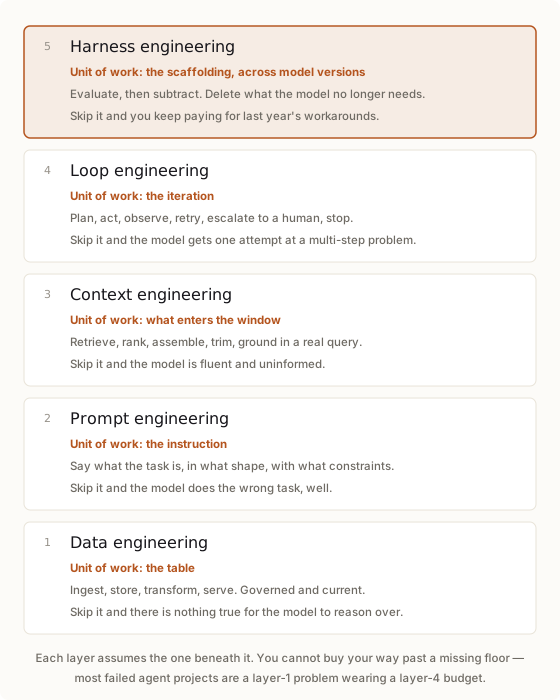
The useful test for each layer is what breaks if you skip it.
Skip data engineering and there is nothing true for the model to reason over. Skip prompt engineering and it does the wrong task, competently. Skip context engineering and it is fluent and uninformed. Skip loop engineering and it gets exactly one attempt at a problem that needs six. Skip harness engineering and you keep paying, forever, for workarounds the current model stopped needing months ago.
Most failed agent projects I heard described on stage were a layer-one problem with a layer-four budget.
What each one actually is
1. Data engineering — the unit of work is the table
Unchanged in purpose since before any of this. Ingest, store, transform, serve; make it current, governed and queryable.
What changed is who consumes it. In 2024 the consumer was a dashboard. In 2026 an agent queries the same warehouse, and it is much less forgiving than a human analyst — it cannot tell that a column is stale, and it will state whatever it finds with total confidence. I built the reference version of this end to end on a real public feed to measure exactly how badly that missing reflex bites, down to a specific number that kept changing for six weeks with nothing ever failing in between.
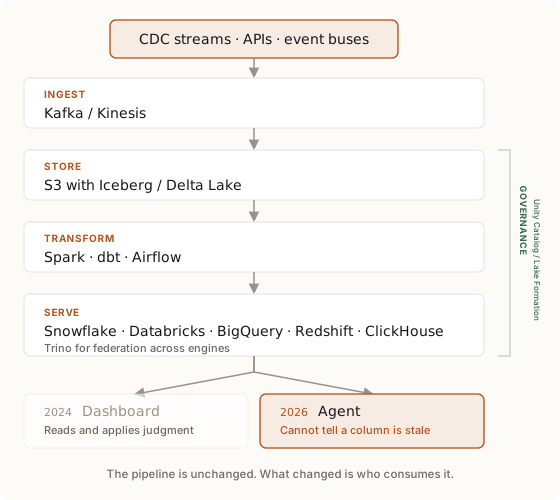
Tools: Kafka or Kinesis for ingest; S3 with Iceberg or Delta Lake for storage; Spark, dbt and Airflow for transformation; Snowflake, Databricks, BigQuery, Redshift or ClickHouse for serving; Trino for federation; Unity Catalog or Lake Formation for governance.
Cost: the largest fixed cost of the five, and almost entirely infrastructure rather than tokens. Speed to build: months. Complexity: high, but well understood, with thirty years of practice behind it.
2. Prompt engineering — the unit of work is the instruction
State the task, the shape of the output, and the constraints.
It is genuinely undervalued now that it is unfashionable. Most "the model can't do this" conclusions I have watched people reach were a prompt that never specified the output shape.
A support team asks a model to classify incoming tickets. The prompt:
Classify this customer support ticket.
The model returns "This appears to be a billing issue related to the customer's subscription renewal" — a sentence. The next ticket gets a bulleted list of observations. The third gets a single word. All three are correct; none is parseable by the routing system downstream.
The shaped version:
Classify this customer support ticket. Return JSON with four fields: category (billing, technical, account, other), urgency (p1, p2, p3), one-sentence summary, and whether it needs escalation (true or false).
Now every response has four fields the routing system can read without a regex. The model did not get smarter; the instruction told it what shape to hand back.
Tools: the model API and a place to keep prompts under version control. That is the whole list. Structured output or tool-calling schemas if the provider offers them. A playground for iteration.
Cost: one model call per task. The floor. Speed to build: hours. Complexity: low — which is exactly why it is worth exhausting before climbing higher. Ceiling: low. It cannot fix missing knowledge, and it cannot survive a task that needs several steps.
3. Context engineering — the unit of work is what enters the window
Retrieve the right material, rank it, assemble it, trim it to fit, and ground the volatile parts in a real query rather than the model's recollection.
A talk in August 2025 framed this better than I have seen since: retrieval is only one of four memory types, and there are four operations you perform on the window — compress, isolate, trim, filter. That is a checklist you can hold a system against. Filter is the one that does no work unless something upstream can actually be checked against — I wired it into the same reference build and watched it drop a real answer, unprompted, the first time an ordinary question happened to touch it.
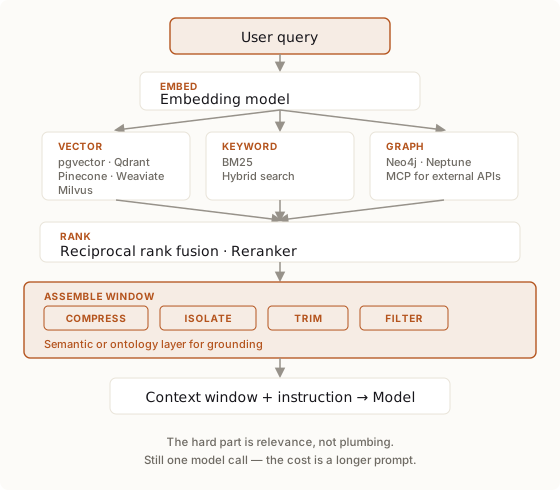
Tools: an embedding model; a vector store (pgvector if you already run Postgres, otherwise Qdrant, Pinecone, Weaviate or Milvus); a graph store such as Neo4j or Neptune when relationships matter more than similarity; hybrid retrieval with BM25 and reciprocal rank fusion; a reranker; a semantic or ontology layer; MCP where the context lives behind someone else's API.
Cost: still one model call, plus retrieval — which is cheap and is not a model call. The token bill rises because the prompt gets longer. Speed to build: weeks. Complexity: moderate, and mostly a data problem wearing new clothes. The hard part is relevance, not plumbing.
4. Loop engineering — the unit of work is the iteration
Plan, act, observe, decide whether to go again, escalate to a human, and know when to stop. This is where cost stops being linear.
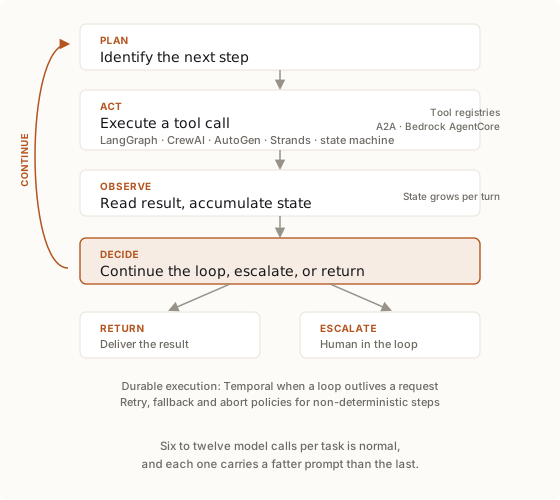
Tools: an orchestration framework (LangGraph, CrewAI, AutoGen, Strands Agents, or hand-rolled state machines — plenty of shipped systems are the last one); tool registries; A2A where agents must talk to other agents; durable execution such as Temporal when a loop outlives a request; explicit human-in-the-loop interrupts; retry, fallback and abort policies; a managed runtime like Bedrock AgentCore if you would rather not build memory, identity and session isolation yourself.
Cost: the step change. A worked example presented at the AWS summit — a single insurance quote — took six loop iterations and four tool calls, with state accumulating on every turn. Six to twelve model calls per task is normal, and each one carries a fatter prompt than the last. Speed to build: weeks to months. Complexity: high, and qualitatively different. You now have a distributed system with non-deterministic components, and the failure modes are partial completion, silent looping and cost explosion rather than a clean error.
5. Harness engineering — the unit of work is the scaffolding itself
The newest of the five, and the only one whose purpose is to make the system smaller.
You have built retries, reflection passes, validators, decomposition steps and prompt gymnastics, each solving a real weakness of the model you had at the time. Then the model improves and some of that scaffolding becomes pure overhead — still running, still costing money, still adding latency, no longer earning it.
Harness engineering is measuring which parts still pay, and deleting the rest.
A document-processing agent built in March runs five steps per document: decompose the PDF into sections, extract structured fields, run a reflection pass to check for missed sections, validate the output against a schema, and retry on failure. By June the model has improved. The eval harness measures each step: decomposition still matters — accuracy drops 23 points without it. Reflection — zero measured impact; the current model stopped missing sections two versions ago. Validation still catches 4% of outputs. Retry triggers on 0.3% of runs, down from 11%.
The reflection pass is deleted. The retry threshold is raised until it fires rarely enough to remove. Two steps gone, three remain. Cost per document: $0.41 to $0.26. Latency: 4.2 seconds to 2.8. Eval scores: unchanged.
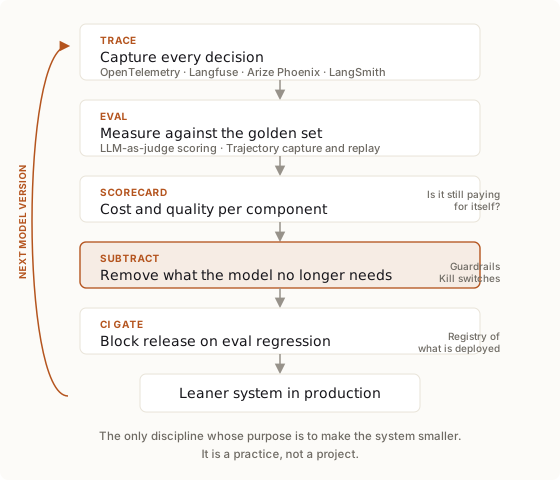
Tools: an eval harness with a golden set; LLM-as-judge scoring; trajectory capture and replay; tracing through OpenTelemetry, Langfuse, Arize Phoenix or LangSmith; cost and token telemetry per decision; CI gates that block a release on an eval regression; guardrails and kill switches; a registry so you know what is deployed.
Cost: the only layer that reduces the bill. Its own cost is evaluation runs and the engineering time to measure honestly. Speed to build: ongoing. It is a practice, not a project. Complexity: moderate technically, hard organisationally — it requires deleting code that currently works.
What it costs to run
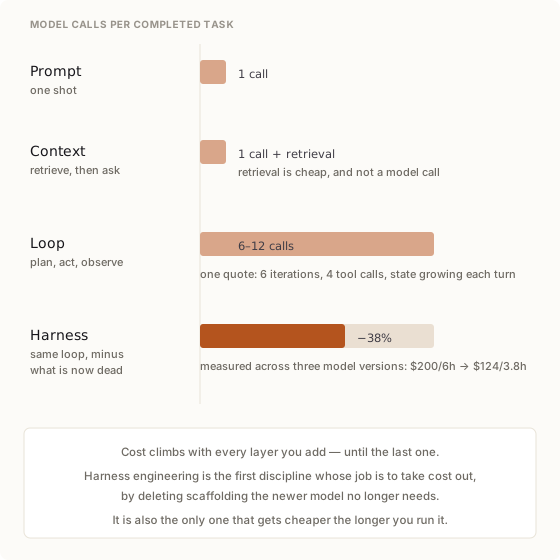
Cost climbs with every layer you add, until the last one.
The harness figure comes from a session at DataHack Summit 2026: the same task run across three successive model versions while scaffolding was deliberately removed. Cost fell from roughly $200 to $124 and wall-clock from six hours to 3.8 — a 38% reduction, achieved by deleting things. The framing was that what was load-bearing in March had become overhead by April.
Side by side
| Data | Prompt | Context | Loop | Harness | |
|---|---|---|---|---|---|
| Unit of work | The table | The instruction | The window | The iteration | The scaffolding |
| Model calls / task | none | 1 | 1 | 6–12 | 6–12, shrinking |
| Dominant cost | Infrastructure | Negligible | Longer prompts | Call count | Eval runs |
| Time to build | Months | Hours | Weeks | Weeks–months | Continuous |
| Complexity | High, familiar | Low | Moderate | High | Moderate |
| Main failure | Stale or wrong data | Wrong task done well | Fluent and uninformed | Silent loops, cost blowout | Paying for dead scaffolding |
| Skip it when | Never | Never | The model already knows | One step suffices | You are pre-production |
Where the money actually goes
Three things worth internalising before you budget.
The jump from context to loop is the expensive one. Going from one call to six is not a 6× cost increase — it is worse, because each iteration carries an accumulated state and a longer prompt. Latency compounds the same way. This is the step where a demo that felt free becomes a product with a unit-economics problem.
Cheap models are underused as guards. Several teams presented the same structure: a small model handles classification, routing or validation, and a frontier model is called only when needed. One pharma-regulatory architecture routed on confidence, escalating to a frontier model only when the in-house small model was unsure. Judging is classification; it does not need the capability you are paying for in generation.
Determinism is a cost lever, not just a correctness one. One team presented an agent system over petabyte-scale telemetry where the model produces a plan and a sandboxed deterministic layer executes it — described as running at zero token burn, with a small model only for final synthesis. Every step you can move out of the model is a step that stops costing per-token and starts being testable.
The order matters
The sequence is not a maturity ladder you graduate along, leaving the previous rung behind. It is a stack, and every layer keeps running.
The mistake I saw described repeatedly on stage is starting at layer four. A team buys an agent framework, builds an elaborate loop, and discovers the problem was that the underlying data was six hours stale and nobody owned the semantic definitions. No amount of orchestration fixes that. The recurring 2026 line — that context, not model quality, is now the differentiator — is really a statement that layers one and three are where the work is, and layer four gets the attention.
The opposite mistake is rarer but real: building a harness for a loop you have not yet proved you need. If one well-constructed call answers the question, the correct number of agents is zero.
References
Most sessions have no published recording. These events tend to livestream whole halls rather than publish individual talks. Where a recording exists it is linked.
| Source | Event | Recording |
|---|---|---|
| Context engineering: four memory types, four window operations | DataHack Summit 2025, Aug 2025 | Not published |
| Worked ReAct example: six iterations, four tool calls for one quote | AWS Summit Bengaluru 2026, Apr 2026 | Not published |
| Agent runtime, registry and managed evaluations | AWS Summit Bengaluru 2026, Apr 2026 | Keynote |
| Confidence-threshold routing between small and frontier models | AWS Summit Bengaluru 2026, Apr 2026 | Not published |
| Deterministic execution layer at zero token burn | DataHack Summit 2026, Aug 2026 | Not published |
| Harness decay and the subtraction principle, −38% measured | DataHack Summit 2026, Aug 2026 | Not published |
| Loop Engineering | DataHack Summit 2026, Aug 2026 | Not published |
| Building real agentic systems — Alessandro Romano | DataHack Summit 2025 | Recording |
| Agentic knowledge-augmented generation — Arun Prakash Asokan | DataHack Summit 2025 | Recording |
| Full hall recordings across three days | CYPHER 2025, Sept 2025 | Day 2, Hall 3 · Day 3, Hall 3 |
Companion to From pipelines to loops, which covers when each of these shifts actually happened, and roughly when.