Kafka to MCP in twenty-four months: what the agentic wave added to the data stack, and what it left untouched
The story everyone tells is that AI replaced the data stack. Two years of attending India's data and AI conferences says something more useful: Kafka, Spark, Airflow, dbt and Iceberg run unchanged from May 2024 to May 2026, four new floors were built on top of them, and the layer that actually got displaced was business intelligence. If you are deciding whether to rebuild your platform to do AI, the evidence says the work is above your serving layer, not below it.
8 min read
Contents
Over the last two years I have been to eleven of India's data and AI conferences, most of them in Bengaluru — the Data Engineering Summit, DataHack Summit, MLDS, CYPHER and the AWS Summit among them.
Recently I sat down and went back through all of it at once, rather than as eleven separate afternoons.
The thing I expected to find was a replacement story: the data stack gives way to the AI stack. That is not what happened.
The 2024 stack
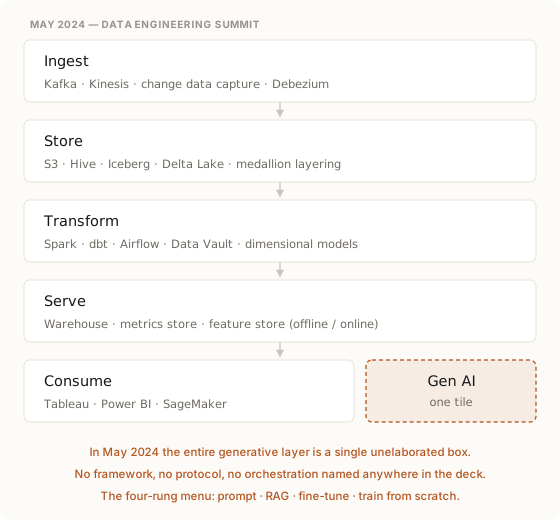
This is May 2024. It is a competent, unremarkable modern data platform, and every component of it is still in production somewhere near you.
Two details are worth pausing on.
The first is a session laying out the complete menu of generative approaches available to an enterprise. It has four rungs: prompt engineering, retrieval-augmented generation, fine-tuning, and training from scratch. Agents are not on the ladder. The same talk argues fine-tuning is only marginally better than retrieval, and mostly not worth it.
The second is a consultancy presenting its target-state platform, on which one service tile reads AI agents and no-code LLM orchestration. One box. Nothing else in the talk names a framework, a protocol, or a tool-calling mechanism. In May 2024 the entire agentic layer was a rectangle with a label.
The 2026 stack
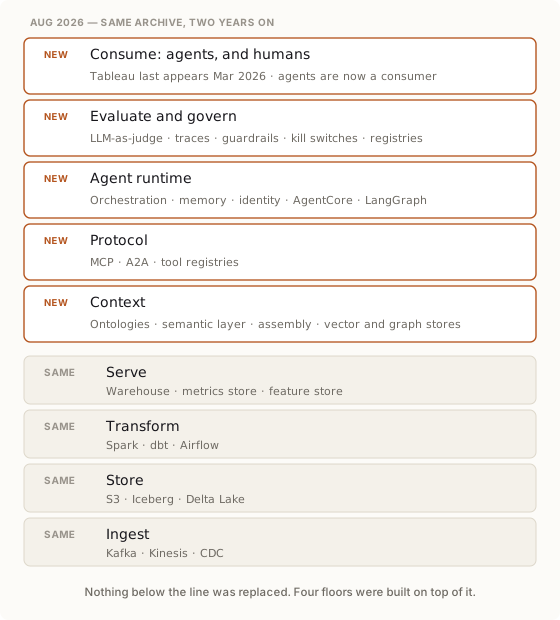
Same conferences, two years later.
The bottom four layers did not move. Kafka, Spark, Airflow, dbt, Iceberg, Delta Lake and S3 all appear in May 2024 and are still being presented in May 2026. Nobody replaced them. Nobody is arguing they should be replaced.
What happened is that four floors were added on top:
- Context — ontologies, semantic layers, assembly, vector and graph stores
- Protocol — MCP, A2A, tool registries
- Agent runtime — orchestration, memory, identity, managed services
- Evaluation and governance — model-graded judging, traces, guardrails, kill switches
The one thing that visibly receded is the top of the old stack. Tableau's last appearance is March 2026. It came up steadily from the first event to roughly the midpoint, then stopped being mentioned. The business-intelligence layer is where the displacement happened — not the pipeline.
What the dates actually show
Because I kept a record as I went, first-appearance dates are checkable rather than remembered. Approximate, since this is what I personally saw presented and not a census.
| Technology | Mentions | First seen | Last seen |
|---|---|---|---|
| Apache Kafka | 29 | May 2024 | May 2026 |
| Apache Spark | 17 | May 2024 | May 2026 |
| Airflow · dbt | 10 each | May 2024 | May 2026 |
| Iceberg · Delta Lake | 11 · 9 | May 2024 | May–Jun 2026 |
| RAG | 12 | May 2024 | Aug 2026 |
| "vector database", generic | 15 | May 2024 | Aug 2026 |
| Tableau | 11 | May 2024 | Mar 2026 |
| Data Vault | 3 | May 2024 | May 2024 |
| MCP | 91 | Aug 2025 | Aug 2026 |
| A2A · LangGraph | 20 · 24 | Aug 2025 | Aug 2026 |
| Qdrant | 6 | Aug 2025 | Aug 2026 |
| Pinecone · Weaviate | 6 · 4 | Mar 2026 | Aug 2026 |
| AgentCore | 16 | Apr 2026 | Jun 2026 |
| Kiro | 38 | Apr 2026 | Jun 2026 |
Four things fall out of that table.
MCP is the fastest-moving thing I saw. First appearance August 2025. By August 2026 it is the single most-mentioned technology at 91 references, ahead of Kafka's 29 accumulated over two years. Nothing else in two years moved like that.
RAG and vector databases were already there in 2024 — but generically. The 2024 decks show an unlabelled vector store. Named products arrive later: Qdrant in August 2025, Pinecone and Weaviate not until March 2026. The category preceded the vendors by about eighteen months.
Kiro went from nothing to 38 mentions in four months. Coding agents were the fastest-adopted product category I saw.
Data Vault appears once and never again. The clearest example of a 2024 modelling concern that simply stopped being discussed.
The unit of work kept moving
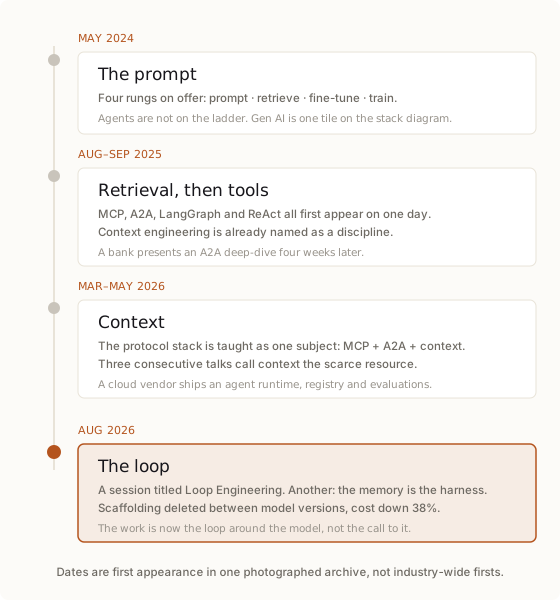
Underneath the technology churn there is a cleaner story about what engineers were being asked to engineer.
2024 — the prompt. The unit of work is the call. You choose a rung on the four-rung ladder and you write a good instruction.
August 2025 — retrieval, then tools. MCP, A2A, LangGraph and ReAct all are first presented on the same day, at the same event. Context engineering is already being named as a discipline: one talk that month demotes retrieval to just one of four memory types and defines four operations over the context window — compress, isolate, trim, filter. Four weeks later a bank presents an Agent2Agent deep-dive.
March–May 2026 — context. The protocol stack gets taught as a single subject. Three consecutive talks in one hall independently argue that context, not model quality, is the scarce resource; two use nearly the same title. A cloud vendor ships an agent runtime, a registry and managed evaluations as products.
August 2026 — the loop. There is a session titled Loop Engineering. Another is called The Memory is the Harness, arguing memory is the only durable advantage. A third shows the same task run across three model versions while scaffolding is deliberately deleted, cutting cost 38% — the argument being that what was load-bearing in March is overhead by April.
Prompt, then retrieval, then context, then the loop. Each shift moves the work one step further from the model call and one step closer to the system around it.
What this means if you are building
Three conclusions I would defend.
Do not rebuild your data platform to do AI. The evidence is that the substrate persisted unchanged through the entire agentic wave. Every 2026 agentic architecture I saw is sitting on Kafka, Iceberg, Spark and dbt. The work is above the serving layer, not below it.
The scarce resource is context, and it is your own data problem. The recurring argument in 2026 is that model quality has stopped being the differentiator and context assembly has become it — which makes it a data-engineering problem wearing new clothes. One talk put the split neatly: short-term memory belongs to whichever framework you chose, long-term memory comes from stores you own.
Protocols arrived before the governance for them. MCP went from first sighting to the most-discussed technology in twelve months. At MLDS in March 2026, a talk reported 66% of audited MCP servers carrying security findings, and names real incidents — a compromised package, a path traversal exposing credentials across thousands of hosted servers, and agent cards that are self-reported with no verification. Adoption ran well ahead of the controls, and the controls are now arriving as products: registries, evaluations, guardrails.
What I would not conclude
What I saw has a shape, and it is worth naming, because it limits what any of this proves.
These are Indian conferences, mostly Bengaluru, heavily weighted to enterprise data and platform audiences. Two of the eleven are vendor-run, and vendor events describe the world in a way that makes their product the answer — the AWS days account for the widest single-event technology surface I recorded, which is a fact about their launch cadence as much as about the industry.
It is also one attendee's view. I went to the sessions that interested me, sat in rooms I chose, and missed entire tracks. The absence of something here is weak evidence at best.
And a conference talk is a claim, not a deployment. It tells you what organisations were willing to say publicly, which is a leading indicator of practice, not a measure of it.
References
Most sessions have no published recording — these events tend to livestream whole halls rather than publish individual talks, and two of the 2026 events published nothing beyond a teaser. Where a recording exists it is linked.
| Source | Event | Recording |
|---|---|---|
| The four-rung generative menu; agentic AI as one platform tile | Data Engineering Summit 2024, May 2024 | Not published |
| Context engineering: four memory types, four window operations | DataHack Summit 2025, Aug 2025 | Not published |
| Agent2Agent deep-dive from a retail bank | CYPHER 2025, Sept 2025 | Day 2, Hall 3 |
| The agent protocol stack; MCP security findings and named incidents | MLDS 2026, Mar 2026 | Not published |
| Agent runtime, registry and managed evaluations | AWS Summit Bengaluru 2026, Apr 2026 | Keynote |
| Context as the scarce resource; three consecutive talks | Data Engineering Summit 2026, May 2026 | Not published |
| Loop Engineering; The Memory is the Harness; harness decay | DataHack Summit 2026, Aug 2026 | Not published |
| Agentic knowledge-augmented generation — Arun Prakash Asokan | DataHack Summit 2025 | Recording |
| Full hall recordings across three days | CYPHER 2025, Sept 2025 | Day 1, Hall 3 · Day 3, Hall 3 |
A companion to the riteangle architecture series. The posts either side of this one describe one system built against this backdrop — match decisions without a model in the loop and context assembly as a first-class subsystem.