Splitting an AI agent into math, code and reason
Ask one language model to score every possible pair in a dating pool, enforce a privacy rule and explain the result, and it will do all three, a little differently each night, with no way to tell which part went wrong. Across thirteen systems I have built, the ones that hold up split the work three ways. Solvers handle anything with a best answer or a probability. Plain code handles anything that must hold every time. The model reads and writes what no rule can describe. The price is translation, because math and code need the problem in numbers and fields, so the riskiest moment moves to the seam where the model hands them over.
22 min read
Contents
- One model doing all three is the tempting design
- Math decides what is best and how likely
- Code decides what is allowed and what is exact
- Reason does what nobody can write a rule for
- Four ways the layers hand off
- Deciding which layer owns a step
- The portfolio, sorted
- The family this belongs to
- The pattern, without cricket or dating apps
- A reference architecture
- References
Every night, the first version of a matchmaker I built asked a language model the same question about every possible pair in the pool: how good a match are these two? In August the pool held 480 live pairs, so one night's run meant 480 model calls. Each one was paid for, each one could come back slightly different if asked twice, and none of them could explain afterward why one pair outscored another.
The replacement asks the model one question per person, once, when their profile changes: read this profile and turn it into a short list of numbers. Scoring all 480 pairs is then a weighted sum, and choosing who actually meets whom is a min-cost flow solve under capacity limits. The model still writes the introduction, after the choice is made.
Analytics India Magazine held its Cypher 2026 conference in Bengaluru from October 7 to 9. In his session there, Abhishek Upperwal, founder and CEO of Soket AI, used a term I have been applying to my own work ever since: MCR, for math, code and reason. He was describing where agentic AI has to go. The argument here is my reading of it: agentic systems need all three as separate layers. Math decides what is best and how likely. Code decides what is allowed and what is exact. Reason, meaning the language model, does the reading and writing that nobody can reduce to a rule.
What follows sorts thirteen of my own systems into those three layers, shows what each layer bought and where each one failed, and maps the idea onto the published architectures it resembles.
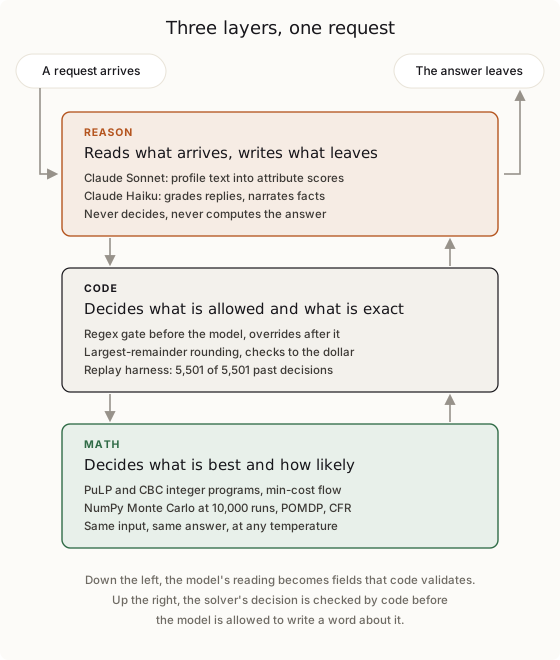
One model doing all three is the tempting design
The obvious build is a single capable model with a long prompt. Give it the data, tell it the rules, ask for the answer and the explanation together. It demos well, and it fails in three distinct ways.
It gets the arithmetic wrong, and nobody can see where. The clearest measured case is old but instructive. In AI21 Labs' 2022 paper on MRKL systems, GPT-3's accuracy on addition fell from 1.0 with two-digit numbers to 0.804 at three digits, 0.255 at four and 0.093 at five. The same paper's model, which handed the sum to a calculator, scored 1.0 from one digit to nine. GPT-3 is several model generations old, so treat that number as history. The paper's other observation has aged better: once the calculator did the sum, every remaining error came from passing it the wrong operands. The mistakes did not disappear. They moved to the handoff, where they could be found.
It costs per question, forever. The matchmaker above paid for one model call per pair, so its bill grew with the number of men times the number of women. Moving the scoring into arithmetic made the nightly cost of scoring effectively zero. The only model spend left is one call per person, made when their profile changes.
It treats every rule as a suggestion. A prompt is an instruction, and a model weighs instructions against everything else in its context. In the same dating app, a man wrote that he was declining an income proof because he was not applying for a loan. The prompt said a refusal must never count against anyone. After four requests, the model flagged him as a concern anyway. In another thread, a woman pasted her own social handle, and a few turns later her agent repeated it to the man. A rule against leaking contact details does not feel like it applies to something already visible in the transcript. Both rules now live in code that runs on every reply the model writes, where the model's opinion of them no longer matters.
Those are the three drivers, in the order they usually bite: correctness you can check, cost you can predict, and rules that actually hold.
Math decides what is best and how likely
The math layer covers any step with a best answer under constraints, or a probability to estimate. It is the oldest layer in this stack and the easiest to skip, because a language model will happily produce something that looks like an optimum.
Four of the systems are decision oracles, and in each one the model never touches the decision. Between them they use four kinds of math:
- Picking a cricket eleven is integer programming. Choose 11 from 15 with a wicketkeeper, at most four overseas players and enough bowlers, maximizing expected runs. The design notes for the women's T20 version put the search space at roughly 3,000 arrangements and an exact solve at under a second. That is why simulated annealing was considered and rejected.
- Win probability is Monte Carlo: 10,000 simulated innings per scenario, a configured count. The same project's documentation records 4 to 5 seconds per prediction, with the simulation as the bottleneck.
- Strategy against an opponent who is choosing too is counterfactual regret minimization. In its sample output, a Game of Thrones turning-point oracle reports an exploitability of 0.064 for the strategy it recommends. The reader can see how far the answer sits from an equilibrium.
- Acting when you cannot see the true state is a POMDP. A spy-thriller oracle keeps a belief over hidden states and picks the action with the best expected value under that belief.
The matchmaker adds a fifth. A weighted dot product scores each direction of a pair, and the geometric mean of the two directions gives the pair's value. Min-cost flow then assigns matches under configured caps of 4 for each man and 12 for each woman. A claim nobody has verified enters the score at 0.3 of its weight, also configured, so an unproven boast can never outweigh a checked fact.
The benefits are specific. The answer is optimal under the stated constraints, which a heuristic or a model can only approximate. The answer is reproducible: the women's T20 design notes put it as the same input state producing the same action whatever the model's temperature. And counterfactuals are exact. Change one weight in the matchmaker and rerun, and you know precisely which pairs moved and why.
The hard side is real. Math needs the problem already in numbers. Somebody has to decide that a profile which says "I run a small bakery and train for marathons" means a 0.8 on ambition and a 0.7 on fitness, and no solver can do that reading. Math can also be confidently wrong. The women's T20 model's headline accuracy was 61%, 11 correct out of 18. Split by outcome class, it was 11 of 11 on one class and 0 of 7 on the other, which is exactly what always predicting the same outcome would score. A solver's precision says nothing about whether its inputs or its evaluation were right. That story has its own post on tiered evidence for a sport with almost no data.
Code decides what is allowed and what is exact
The code layer covers anything that must hold every single time, or must match to the cent. It differs from math in its question. Math asks what the best choice is. Code asks whether this choice is permitted, and whether these numbers add up.
It shows up in four positions:
- A gate in front of the model. A patient-education chatbot for a clinic checks every message against a fixed list of crisis phrases, in English, Hindi and Kannada, before the model is called at all. A match skips the model and returns escalation guidance immediately. A list cannot be talked out of its judgment by the message it is reading.
- Overrides after the model. The two dating-app incidents above became functions that run on every reply: a refusal turn forces the concern flag back to neutral, and outbound text is scrubbed of emails, phone numbers and handles.
- Exact arithmetic. A weekly profitability report allocates spend across segments. Each segment's share is rounded with the largest-remainder method so the shares sum to exactly 100.00%, and the pipeline checks that segment costs add up to actual spend within one dollar.
- Proof before a change ships. An agent edits a lead-routing configuration from plain-English requests. It is trusted only because a reimplementation of the routing engine first reproduced every decision production had made over nine days. That was 5,501 of 5,501, zero divergences, against a target of under 0.5% set in advance. Every proposed edit is replayed against that corpus before a human sees it.
Code also wins some jobs a model would do more flexibly. In a job-search agent, deciding whether a question should be answered from a database or from documents is a small set of rules, scored at 0.974 routing accuracy over 38 test questions. A model classifier was rejected because it would answer differently across runs and could not be unit-tested. The trigger for building it was a document search that returned a stale paraphrase of a weekly volume figure, three times too low. A written instruction to take numbers from the database had not prevented it.
The benefits: rules are enforced rather than requested, every rule is testable in isolation, and a failure leaves a log line naming the rule that fired.
The hard side is just as concrete. The clinic's output filter looks for a dosage instruction written as the word take, then a number, then mg or IU. It catches "take 75 mg" and replaces the reply. It misses "take 75 units" because nobody wrote that pattern, and it misses "the usual dose is 75 mg" because that sentence never says take. Code catches exactly what someone enumerated and nothing else. That is its strength when a domain expert must sign off every rule, and its weakness everywhere a paraphrase is possible.
Reason does what nobody can write a rule for
The reason layer is the language model, kept to the jobs only it can do:
- Reading. Turning a free-text profile into attribute scores. Inspecting a week's input files when the column names have drifted, where an exact string check is either too strict or too loose.
- Translating intent. Turning a request like "send Spanish-speaking leads from these three states to the new team" into a structured patch against a configuration, with output forced through a schema and one corrective retry.
- Judging meaning. Checking whether a written analysis actually discusses the gap the table shows, which is a question about prose rather than numbers.
- Writing. Every oracle above ends with a model turning a finished decision trace into a brief. The cricket narrator's instructions forbid stating any figure that is absent from the trace.
The benefit is reach: unstructured in, unstructured out, at the two edges of a system where people live.
The judging job is the one most easily lost. The weekly report pipeline was built twice. In the first build, a model audited the final report, including whether the figures quoted in the written findings matched the table and whether the yield gap was explicitly discussed. The second build replaced that auditor with plain Python, which was the right call for four of its five checks. It also silently dropped the prose-against-table check, because no deterministic function can read a paragraph. The rewrite looked strictly better and quietly lost the one check only a model could run. The full comparison is in an LLM auditor and a deterministic one in the same pipeline.
The model's own limits set the boundaries of everything above. It cannot be regression-tested, its answers drift between runs, and it treats rules as weights. Those limits are why it reads and writes and does not decide.
Four ways the layers hand off
Across the thirteen systems, the layers connect in only four shapes.
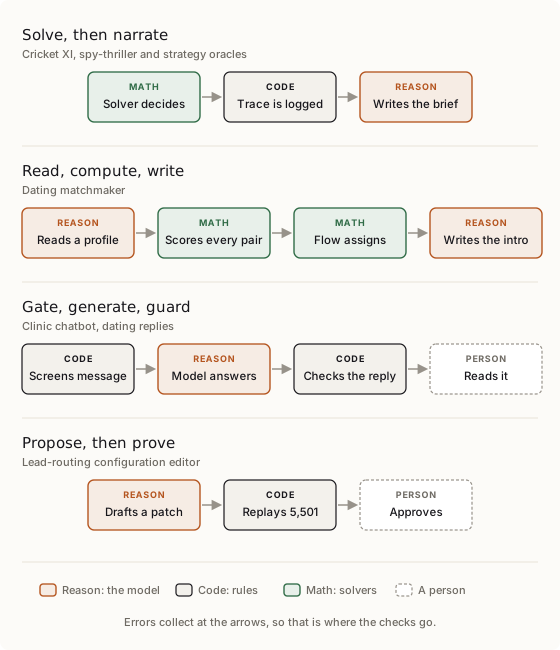
Solve, then narrate. Math produces a decision trace, and the model turns it into prose. All four oracles work this way. So does a graph-retrieval demo, where a database traversal computes why a match stalled and a small model narrates the facts for about a tenth of a cent per run. The test is to switch the model off. The cricket optimizer still returns the eleven and the win probability; it only loses the explanation.
Read, compute, write. The model is at both edges and math is in the middle. The matchmaker is the example: profiles in, vectors out, a solve, then an introduction written for a match that already exists.
Gate, generate, guard. Code on both sides of a model whose output reaches a person. The clinic bot and the dating-app reply agent both run this way.
Propose, then prove. The model drafts a change, and code proves what the change would do before anyone accepts it. The routing editor is the example.
The MRKL finding applies to all four. When the computation is exact, the errors collect at the seams: a model passing the wrong operand, extracting the wrong field, naming a player the solver never picked. So the seams are where checks belong. Give every handoff a schema that fails loudly, and check every entity the narrator mentions against the trace it was handed.
Deciding which layer owns a step
Most steps sort themselves once you ask the questions in the right order.
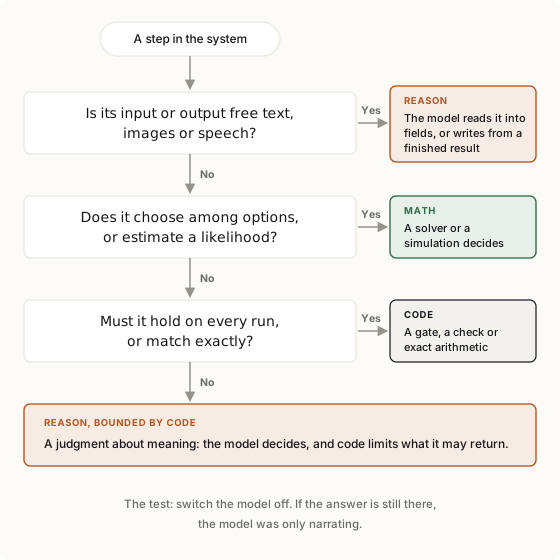
Take two steps from the dating app. "Is this message a refusal to provide proof?" is a judgment about meaning, so the model answers it. "What happens to the concern flag on a refusal turn?" must hold every time, so code answers it. One sentence of product policy splits across two layers, and the split is the design.
The portfolio, sorted
Here are all thirteen systems, marked by which layer owns each system's key step and which layers support it. A fourth column covers the systems where a person keeps the final call.
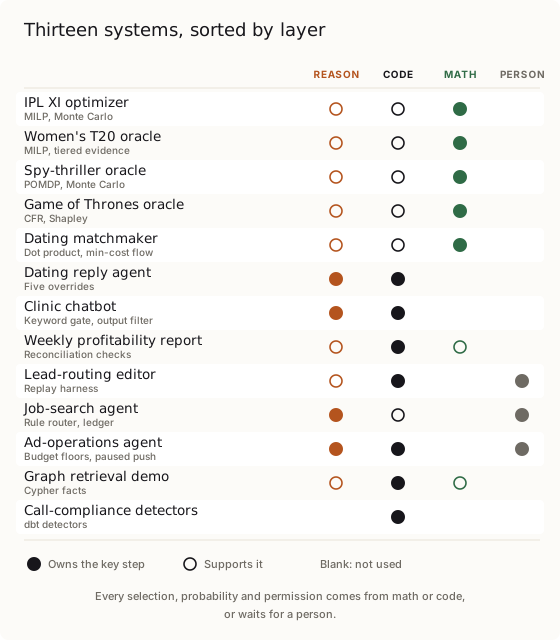
Two things stand out. Every selection, assignment, probability, figure and permission in the thirteen comes from math or code, or waits for a person. Where the model does offer a verdict, it has company:
- A job-fit call and a read on whether an ad is working both stop at a person who decides what to do with them.
- A concern flag on a match, and a grade on an outgoing message, both feed rules in code that have the last word.
And wherever the model's prose reaches someone other than the person who asked, code or a person checks it first. The clinic's answers pass a filter, the dating replies pass five overrides, outreach drafts wait for a person to send them, and ads are created paused for a person to switch on.
None of this was designed top-down. Each system arrived at the split on its own, usually after an incident. The term from the conference names a pattern that had already shown up thirteen times.
The family this belongs to
The idea has relatives, and most of them have a name. The table lists the closest ones I could verify, with the result each source reports.
| Architecture | Split it proposes | Math | Code | Reason | Reported result |
|---|---|---|---|---|---|
| MRKL systems, AI21 Labs, 2022 | A router sends each input to a neural or symbolic expert | Calculator | Symbolic experts | Router and fallback model | 1.0 addition accuracy up to nine digits after training on one |
| PAL, CMU, 2022 | Model writes a program, interpreter runs it | Inside the program | Python interpreter | Decomposition | 15 points over chain-of-thought on GSM8K |
| Program of Thoughts, 2022 | Separates computation from reasoning | Inside the program | Interpreter | Reasoning as code | About 12% over chain-of-thought on average |
| Logic-LM, UCSB, 2023 | Model formalizes, a symbolic solver infers, errors flow back | Logic solver | Solver interface | Formalization | 39.2% over standard prompting, 18.4% over chain-of-thought |
| Chain of Code, 2023 | Model writes code; lines that cannot run are simulated by the model | Partial | Interpreter | Simulates the rest | 84% on BIG-Bench Hard |
| OptiMUS, Stanford, 2024 | Model formulates a mixed-integer program, a solver solves it | MILP solver | Solver code | Formulation and debugging | Over 20% better than prior methods on easy sets, over 30% on hard |
| LLM-Modulo, ASU, 2024 | Model proposes plans, external verifiers check them | Verifiers | Critics | Candidate generation | Position paper |
| AlphaGeometry, DeepMind, 2024 | Model suggests constructions, a deduction engine proves | Symbolic engine | None separate | Construction ideas | 25 of 30 olympiad problems; prior best 10 |
| Thinking fast and slow in AI, IBM et al., 2020 | Neural System 1, symbolic System 2, a layer that chooses | System 2 | Metacognition | System 1 | Vision paper |
| Compound AI systems, Berkeley, 2024 | Many interacting components beat one model | Any | Any | Any | Industry framing |
| Building effective agents, Anthropic, 2024 | Workflows on predefined code paths versus autonomous agents | None | Control flow | Agent steps | Guidance |
| 12-Factor Agents, HumanLayer | Mostly deterministic software with model steps placed inside it | None | Owns control flow | Placed steps | Practitioner guide |
Three differences matter.
Most of these merge math and code. PAL and Program of Thoughts put the math inside a generated program, and the program is also the enforcement. MCR keeps them apart, and the reason is how you test each one. Code is tested by unit tests: this input must be refused, these shares must sum to 100.00%. Math is tested by optimality and calibration: is this the best eleven, and do predicted 70% chances come true about 70% of the time? A component doing both jobs gets neither test properly.
Several put the model upstream as the formulator. In OptiMUS and Logic-LM, the model writes the optimization problem or the logic program, then a solver runs it. In most of my systems the problem is fixed in code and the model only supplies inputs and reads outputs. That is safer for a recurring decision. Formulation by a model suits one-off problems where nobody has written the program yet.
The fast-and-slow analogy fits, with the model as the fast half. In the IBM framing and in DeepMind's description of AlphaGeometry, the neural model is the fast, intuitive System 1, and the symbolic engine is the slow, deliberate System 2. It is tempting to cast a model that thinks before it answers as System 2. In this architecture it stays System 1, however long it thinks. It gives the quick, fluent read of messy input, and the decision belongs to the slow machinery you can check.
Chain of Code is the useful counterexample. It deliberately blurs the line between code and model, letting the model pretend to execute what the interpreter cannot. That is a good trade for a benchmark. In a system that sends money, messages or matches, the line is the point.
The pattern, without cricket or dating apps
Math decides what is best and how likely. Code decides what is allowed and what is exact. The model reads what arrives and writes what leaves, and every decision in between is made by something you can test.
| If you are building | Reason reads and writes | Math decides | Code enforces |
|---|---|---|---|
| Insurance claims | Reads adjuster notes and photos into fields; drafts the letter | Fraud likelihood, reserve estimate | Policy limits, coverage exclusions, approval thresholds |
| Lending | Reads bank statements and payslips | Default probability, pricing | Regulatory caps, affordability rules, adverse-action reasons |
| Delivery dispatch | Parses customer emails and address notes | Vehicle routing under time windows | Driver hours, vehicle capacity, restricted zones |
| Hospital scheduling | Summarizes referral letters | Operating room and staff scheduling | Red-flag escalation rules, consent checks |
| Retail pricing | Reads competitor pages and supplier emails | Price optimization against elasticity | Price floors, minimum advertised price, margin guards |
| Contract review | Extracts clauses and summarizes deviations | Exposure scoring across a portfolio | Playbook rules, signature authority, deadline calendaring |
Three design choices carry over to any of them.
Make the model removable. Build a switch that runs the system without the model and confirm the decision is still there. If it is, the model was narrating. If it is not, the model was deciding, and you should know which one you built.
Put a schema at every seam. The errors in a layered system collect where one layer hands to another. A typed contract between the model and the solver turns a silent misread into a loud failure at the exact step where it happened.
Move a rule into code the first time a prompt fails to hold it. A rule that lives only in a prompt is a request. The first incident is the cheapest moment to write the function, and every one of the overrides above has its incident written next to it.
A reference architecture
Every component here is something I have run:
- Reason: Claude Sonnet for extraction and writing, Claude Haiku for grading and short narration. Structured output forced through a schema, with one corrective retry before failing.
- Seams: Pydantic models between every agent, so a malformed handoff stops the run instead of flowing downstream.
- Math: PuLP with the CBC solver for integer programs; NumPy for vectorized Monte Carlo; a min-cost flow solver for assignment; NetworkX for graph problems; scikit-learn for Platt calibration once real outcomes exist.
- Code: regex gates in front of the model; pure override functions after it; reconciliation checks on every figure; dbt contracts and freshness tests on the data; a replay harness over captured production decisions for anything that edits configuration.
- Orchestration: LangGraph, with error routers that end the run before the narrator can write about corrupted state.
- Record: a runs table holding the input, the solver's decision trace and the narration separately, so any brief can be checked against the numbers behind it.
The things that are cheap on day one and expensive later:
- The no-model switch. Retrofitting it means untangling every place the model quietly made a choice.
- Logging the decision trace before narration. Without it, a wrong brief cannot be traced to a wrong number or a wrong sentence.
- Capturing production decisions for replay. You cannot replay a history you never recorded.
- A name check on the narrator. Every entity in the prose must exist in the trace: a few lines of code that catch the most embarrassing class of error.
References
Talks
- Abhishek Upperwal, Soket AI, session at Cypher 2026, Bengaluru, October 7, 2026. Event coverage: Cypher 2026 Day 1 highlights, Analytics India Magazine. Company research focus: soket.ai.
Papers
- Karpas et al., MRKL Systems, AI21 Labs, 2022.
- Gao et al., PAL: Program-aided Language Models, 2022.
- Chen et al., Program of Thoughts Prompting, 2022.
- Pan et al., Logic-LM, 2023.
- Li et al., Chain of Code, 2023.
- AhmadiTeshnizi, Gao and Udell, OptiMUS, 2024.
- Kambhampati et al., LLMs Can't Plan, But Can Help Planning in LLM-Modulo Frameworks, 2024.
- Booch et al., Thinking Fast and Slow in AI, 2020.
- Trinh, Luong et al., AlphaGeometry, as described in DeepMind's announcement, January 2024.
Industry and tooling
- Zaharia et al., The Shift from Models to Compound AI Systems, Berkeley AI Research, 2024.
- Anthropic, Building effective agents, December 2024.
- HumanLayer, 12-Factor Agents.
Each layer has its own deeper post: min-cost max-flow picks the match, MILP, CFR and POMDP chosen by what you cannot observe, deterministic overrides after generation, a keyword gate ahead of the model and a replay harness gating an agent's edits.